
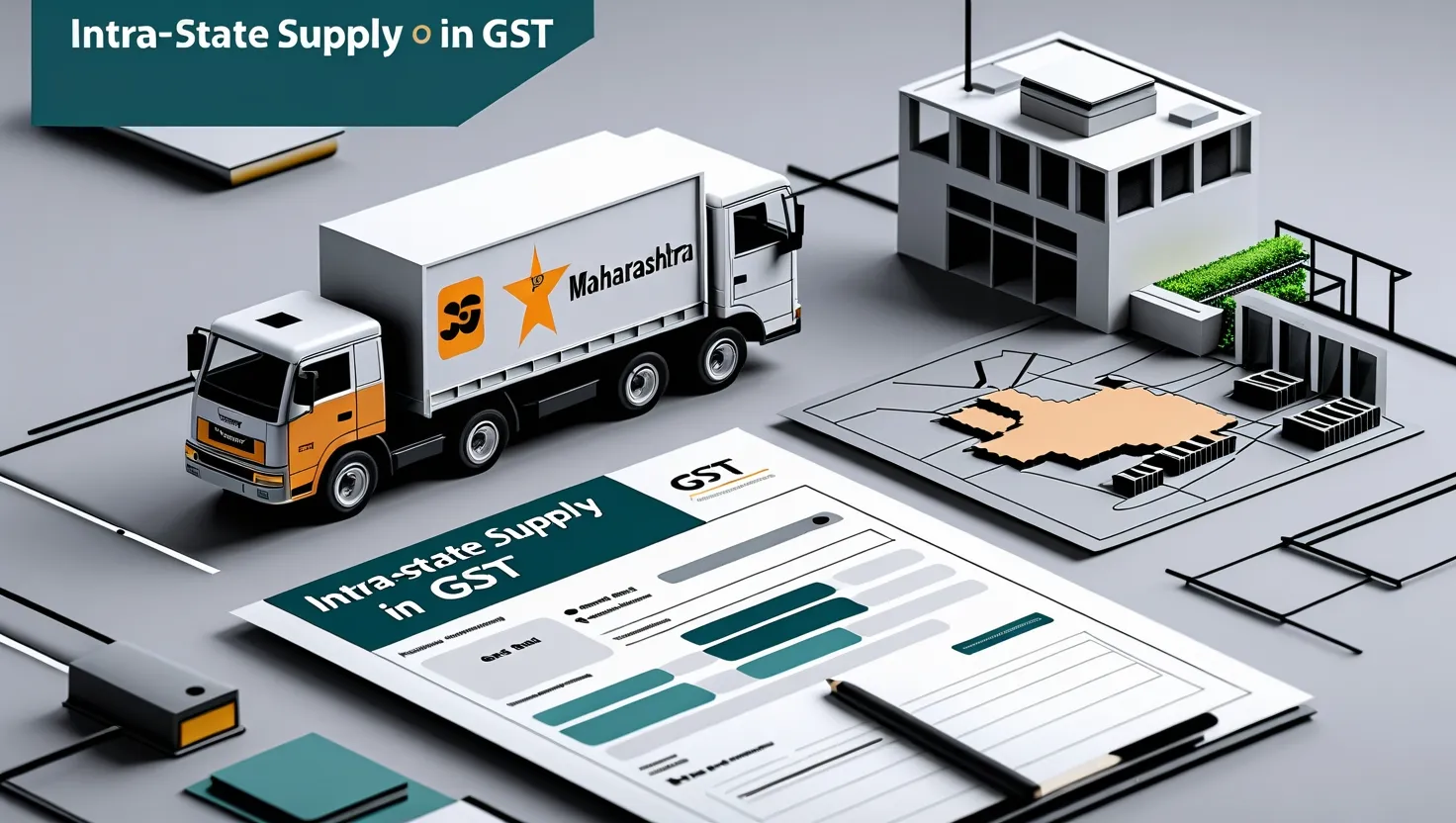
What Is Intra-State Supply? #
Intra-State Supply refers to selling goods or services within the same state. For example, if your business is based in Mumbai and you sell items to a customer in Mumbai or another city within Maharashtra, it qualifies as an Intra-State Supply.
In contrast, when goods move across state lines, it is considered an Inter-State Supply. Understanding this distinction is crucial because it directly affects your tax obligations. Mistaking one for the other can result in fines and delays.
How Does GST Work for Intra-State Supply? #
When selling goods or services within your state, two types of GST come into play:
- CGST (Central Goods and Services Tax)
- SGST (State Goods and Services Tax)
For instance, if you sell a bag for ₹1,000 and the GST rate is 18%, you would charge:
- ₹90 as CGST
- ₹90 as SGST
This means the total GST amount is ₹180, and the final price the customer pays would be ₹1,180.
- CGST goes to the central government.
- SGST goes to your state government.
Why Is Intra-State Supply Important? #
Understanding Intra-State Supply is essential for small businesses. Here’s why:
- Correct Tax Charges: Knowing whether your transaction is Intra-State ensures that you charge the correct taxes.
- Avoid Mistakes: Correctly classifying your sales helps you avoid costly errors.
- Proper Record-Keeping: Accurate tax records simplify filing and help in audits.
- Smooth Business Operations: By adhering to GST rules, you avoid legal problems and penalties, enabling business growth.
Key Points to Know About Intra-State Supply #
Where the Sale Happens
If both the seller and the buyer are located in the same state, it is an Intra-State Supply. The location of the city doesn’t matter, as long as the state is the same. Even if branches transfer goods within the same state, they still consider it an Intra-State supply.
Tax Types in Intra-State Supply
In Intra-State Supply, you must charge both CGST and SGST. People generally split these taxes equally. For example, if the total GST rate is 12%, you will charge:
- 6% CGST
- 6% SGST
GST-Included Invoices
Invoices should comply with GST rules. Ensure your invoices include the following:
- GSTIN: Your business’s unique GST identification number.
- Buyer’s GSTIN: If the buyer has a GSTIN.
- CGST and SGST Amounts: Clearly stated.
- HSN or SAC Code: The code for goods or services.
- Item and Tax Breakup: Clear descriptions of the items and tax amounts.
These invoices help maintain accurate records and avoid penalties.
When Must You Register for GST? #
If your business’s annual turnover exceeds ₹20 lakh, you must register for GST. In certain states, this limit may be as low as ₹10 lakh. Once registered, you must:
- Keep detailed records.
- File monthly GST reports.
- Submit an annual GST return.
Exemptions
Some businesses are exempt from paying GST. Examples include:
- Small businesses below the turnover threshold.
- Certain educational and healthcare services.
- Agriculture-based businesses.
Knowing whether your business is exempt helps avoid unnecessary paperwork and tax payments.
Time of Supply #
The time of supply refers to the date when someone must pay GST. For goods, this occurs when the:
- Someone creates the invoice.
- Someone should have created the invoice.
- Payment is received (whichever happens first).
For services, the time of supply is determined by the earliest of:
- Invoice being sent,
- We are receiving the payment.
Understanding the time of supply helps you file taxes on time and avoid penalties.
Why Should Small Businesses Learn About Intra-State Supply? #
- Easier Planning: Understanding when and how much tax to charge helps prevent confusion and costly mistakes.
- Save Money Using Tax Credits: Businesses can claim Input Tax Credit (ITC) for goods and services used for business purposes. This reduces your overall tax burden and saves money.
- Stay Out of Trouble: By paying the right amount of tax on time, you avoid penalties. Proper records also ensure smooth business operations, especially when applying for loans.
- Better Budgeting: Knowing your tax obligations enables better financial planning. You can forecast costs and set a more accurate budget.
Easy Steps to Follow for Intra-State Supply #
- Identify Intra-State Sales: Check whether both the buyer and seller are in the same state.
- Get Registered for GST: If your turnover exceeds the threshold, go to the GST website to obtain your GSTIN.
- Make Clean Invoices: Use software to create invoices that separate CGST and SGST.
- Verify GST Amounts: Ensure the correct tax amounts are applied.
- File GST Returns: File monthly GST returns (GSTR-1 and GSTR-3B).
- Stay Up-to-Date: Keep updated records of sales and expenses to ensure compliance.
- Handle Questions Efficiently: Train staff or hire someone to handle tax queries promptly.
Common Problems and Solutions #
- Mixing Up State Types: Ensure the correct state is listed in both the buyer’s and seller’s GSTIN to avoid charging the wrong tax.
- Paper Records Issues: Paper-based records can lead to errors and missed invoices.
- Missing GST Law Changes: Staying updated with GST law changes is crucial to remain compliant.
- Late Filing of Returns: Late filings incur penalties.
- Input Tax Credit Confusion: Missing out on ITC means paying more tax.
- Using Outdated Tools: Relying on books or Excel can cause delays.
Best Habits for Easy GST Compliance #
- Train Your Staff: Educate your team about GST rules, billing processes, and the importance of accuracy.
- Use GST-Compatible Software: Tools like Vyapar app simplify GST invoice creation, help in filing returns, and tracking sales.
- Consult Experts: When in doubt, seek professional advice to ensure compliance.
- Regularly Review Records: Routine checks help catch errors early.
How Vyapar App Helps #
- GST-Ready Invoices: Easily create GST-compliant invoices.
- Auto Tax Calculation: The app calculates CGST and SGST automatically.
- Trustworthy Reports: Monitor your business performance with easy-to-read reports.
- User-Friendly: It is easy to use, even for those without technical expertise.
FAQ’s: #
What are CGST and SGST?
CGST is the central tax, while SGST is the state tax. Both are applicable for Intra-State sales.
How can I know if my sale is intra-state?
If both buyer and seller are in the same state, it’s an Intra-State sale.
What happens if I get the tax type wrong?
You may incur penalties and lose the ability to claim ITC.
Do I need to register for GST?
Yes, if your turnover exceeds ₹20 lakh or ₹10 lakh in certain states.
Can I be exempt from GST?
Yes, if your business falls below the threshold or deals in exempt goods/services.
Conclusion #
Understanding Intra-State Supply in GST isn’t complicated. With the right tools and knowledge, small businesses can ensure they’re charging the correct taxes and maintaining compliance.
Use Vyapar App to handle billing, stock & payments all in one place.
Make bills, track stock, and handle payments in one place.