The Best Inventory Management Techniques for Small Retail Businesses

Introduction
For small retail businesses, inventory is both an opportunity and a risk. Too little stock, and customers walk away. Too much stock, and cash gets trapped on shelves. Most retail problems cash flow stress, low profits, storage issues can be traced back to poor inventory management.
The good news is this: you don’t need complex software or MBA-level formulas to manage inventory well. You need the right techniques, applied consistently.This guide walks you through the best inventory management techniques for small retail businesses, including a clear FIFO vs LIFO explanation, how to calculate reorder point, understand inventory turnover ratio, methods for reducing dead stock, and a practical stock-taking procedure. Along the way, imagine simple charts, shelves, and dashboards because that’s how inventory should be seen: visually, not just numerically.
Why Inventory Management Matters More Than Sales
Picture a bar chart in your mind.
- One bar shows sales value
- Another shows inventory value
- A third shows cash balance
In poorly managed retail businesses, the inventory bar is tall, but the cash bar is short. That imbalance creates stress.
Inventory management isn’t about counting products. It’s about:
- Freeing up cash
- Preventing losses
- Ensuring availability
- Supporting growth
Let’s break down the techniques that actually work on the ground.
Choosing Your Inventory Valuation Method
While accounting standards like AS-2 (Accounting Standard 2 in India) generally prefer FIFO, choosing the right method impacts your reported profits and tax liability
| Method | Best For | Impact on Tax (in inflation) | Recommendation | Why this method is used |
| FIFO | FMCG, Pharma, Apparel | Higher reported profit | Mandatory for perishables | Oldest stock goes out first, which matches how real inventory actually moves. It avoids expired stock piling up and gives a more realistic closing value. |
| LIFO | Non-perishables (Coal, Stone) | Lower reported profit | Not recommended for retail | Newer expensive stock is treated as sold first, which reduces profit on paper. Works only where material doesn’t degrade and pricing volatility matters. |
Let’s start with a core concept.
FIFO (First In, First Out)
FIFO means the items you buy first are the items you sell first.
Visualise a shelf:
- Old stock is placed in front
- New stock goes behind
- Customers naturally pick older items first
This is the most practical method for retail, especially for:
- FMCG
- Groceries
- Medicines
- Apparel
- Electronics accessories
Why FIFO works
- Reduces expiry and damage
- Prevents old stock from becoming dead stock
- Reflects real-world movement of goods
If you imagine a line graph of inventory age, FIFO keeps that line low and flat.
LIFO (Last In, First Out)
LIFO means the most recently purchased stock is sold first.
Visualise a stack:
- New boxes are opened first
- Old boxes stay at the bottom
LIFO is rarely practical for small retail because:
- Older stock stays unsold
- Risk of expiry and obsolescence increases
- Shelf space gets wasted
LIFO may make sense in some accounting or bulk-material environments, but for most retail businesses, it creates more problems than it solves.
Retail takeaway:
FIFO is the default, safest, and most realistic method for small retailers.
Calculating Reorder Point (So You Never Run Out of Stock)
One of the biggest inventory mistakes retailers make is reordering based on “gut feeling”.
Let’s replace guesswork with clarity.
What Is Reorder Point?
Reorder Point is the stock level at which you should place a new order so that fresh stock arrives just before current stock runs out.
Imagine a line chart:
- X-axis: Time
- Y-axis: Stock quantity
As stock moves down daily, reorder point is the alarm line, the moment you act.
Simple Reorder Point Formula
Reorder Point = Average Daily Sales × Supplier Lead Time
Example:
- You sell 10 units per day
- Supplier takes 5 days to deliver
Reorder Point = 10 × 5 = 50 units
When stock reaches 50 units, you reorder.
Adding Safety Stock (Smart Retailers Do This)
Real life isn’t perfect. Deliveries get delayed. Demand spikes.
So imagine a shaded buffer area below the reorder line, that’s safety stock.
Reorder Point = (Average Daily Sales × Lead Time) + Safety Stock
This prevents stockouts during surprises.
Inventory Turnover Ratio: Are You Selling Fast Enough?
Now let’s zoom out and look at inventory performance.
Picture a dashboard gauge:
- Green zone: Healthy movement
- Yellow: Slow
- Red: Dead stock building up
That gauge is the Inventory Turnover Ratio.
What Is Inventory Turnover Ratio?
Inventory Turnover Ratio tells you how many times your inventory is sold and replaced during a period.
Simple formula: Inventory Turnover = Cost of Goods Sold ÷ Average Inventory
How to Read the Number
- High turnover = Stock is moving fast
- Low turnover = Stock is sitting idle
Example:
- Annual cost of goods sold: ₹12,00,000
- Average inventory: ₹3,00,000
Turnover = 4
This means inventory cycles 4 times a year.
What’s a “Good” Turnover?
There’s no single perfect number, but visually:
- Fast-moving retail: Higher bars (6–10)
- Apparel / lifestyle: Medium bars (3–5)
- Specialty items: Lower bars (2–3)
The goal is improvement, not perfection.
Reducing Dead Stock (Freeing Trapped Cash)
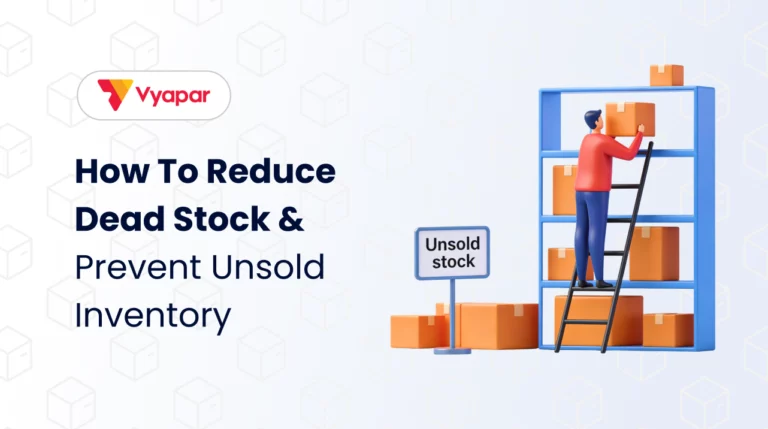
Dead stock is inventory that doesn’t sell.
Imagine a pie chart:
- One slice = fast-moving
- One = slow-moving
- One = dead stock
Dead stock is the slice that quietly eats your profit.
Why Dead Stock Is Dangerous
Dead stock:
- Blocks cash
- Takes shelf space
- Loses value over time
- Increases risk of damage or expiry
It looks harmless, but it slowly weakens your business.
Practical Ways to Reduce Dead Stock
- Identify it clearly
- No movement in 60–90 days
- Visually tag it in your system or shelves
- Discount strategically
- Bundle slow items with fast sellers
- Offer limited-time clearance
- Stop reordering
- Dead stock should never be replenished
- Dead stock should never be replenished
- Return or exchange (if possible)
- Some suppliers allow adjustments
- Some suppliers allow adjustments
- Learn from it
- Dead stock is feedback, not failure
- Dead stock is feedback, not failure
Reducing dead stock improves cash flow immediately.
Stock-Taking Procedure: How to Count Without Chaos
Stock-taking sounds boring, but it’s one of the most powerful controls in retail.
Imagine a checklist view:
- Shelf by shelf
- Item by item
- Tick, verify, confirm
That’s how stock-taking should feel.
Why Stock-Taking Is Non-Negotiable
Stock records without physical verification are assumptions.
Stock-taking helps you:
- Detect theft or pilferage
- Catch billing or entry errors
- Identify damaged goods
- Maintain accurate reorder decisions
Simple Stock-Taking Procedure
- Choose a fixed frequency
- Monthly for fast-moving items
- Quarterly for slow-moving items
- Pause movements
- No sales or purchases during counting
- No sales or purchases during counting
- Count physically
- Not by memory, not by reports
- Not by memory, not by reports
- Match with records
- Identify excess, shortage, or mismatch
- Identify excess, shortage, or mismatch
- Investigate differences
- Damage, theft, wrong entries
- Damage, theft, wrong entries
- Update records immediately
Think of stock-taking as resetting your inventory compass.
The ABC Analysis
ABC Analysis classifies inventory into three buckets based on how much value they contribute, not just quantity. This helps in prioritizing Your Cash, Not all stock is created equal. In 2025, retailers use ABC Analysis to prevent cash traps
- Category A (High Value): Top 20% of items contributing 70–80% of revenue. Action: Tight control, daily tracking.
- Category B (Moderate): 30% of items contributing 15–20% of revenue. Action: Weekly tracking.
- Category C (Low Value): 50% of items contributing 5% of revenue. Action: Bulk ordering, monthly tracking.
| Category | % of Items | % of Inventory Value | Typical Control |
| A | 10–20% | 60–80% | Very tight control |
| B | 20–30% | 15–25% | Moderate control |
| C | 50–70% | 5–10% | Simple, low-cost control |
Why Companies use ABC Analysis?
Because not every item deserves the same attention, what it really means is you focus your energy where the money is.
How it’s calculated?
- List all the inventory items with annual consumption value.
Annual usage x Cost Per Unit - Sort items from highest value to lowest.
- Calculate cumulative percentage of total value
- Assign –
- Top – 70 – 80% Value to Category A
- Next – 15 – 25% Value to Catergory B
- Remaining to Category C
Visual Habit: Always “See” Your Inventory
Good retailers don’t just read inventory reports. They see inventory.
- Bar charts for category-wise stock
- Line charts for fast vs slow movers
- Highlighted lists for dead stock
- Reorder alerts as red markers
When inventory is visible, decisions become easier and faster.
How Small Retailers Make Inventory Management Easier
Manual methods work up to a point.
As SKUs increase, retailers benefit from:
- Real-time stock updates
- FIFO-based selling
- Automatic reorder alerts
- Clear aging reports
That’s why many small retailers use simple systems like Vyapar, where inventory movement, sales, and stock visibility come together without complex setup. The goal isn’t technology, it’s control and clarity.
Final Thoughts
Inventory management is not about perfection. It’s about balance.
Using the right techniques FIFO over LIFO, smart reorder point calculation, monitoring inventory turnover ratio, actively reducing dead stock, and following a disciplined stock-taking procedure, helps small retail businesses stay liquid, profitable, and stress-free.
When inventory starts working for you instead of against you, growth becomes easier and risks become manageable.
Frequently Asked Questions (FAQs)
- Should inventory methods change during festival seasons?
Yes. During high-demand seasons, reorder points should be adjusted upward and stock-taking frequency increased to prevent stockouts and shrinkage.
- Is it better to overstock fast-moving items?
Only up to a limit. Overstocking fast movers can still block cash if demand slows unexpectedly. Balance is key.
- ICan inventory mistakes affect GST compliance?
Yes. Incorrect stock records can lead to wrong valuation, incorrect returns, and scrutiny during audits.
- How do retailers manage inventory across multiple outlets?
By tracking stock location-wise and monitoring inter-branch transfers separately to avoid duplication or loss.
- Does inventory age matter if products don’t expire?
Yes. Even non-expiry items lose relevance, style, or demand over time, turning into dead stock.
- How soon should a new product’s performance be reviewed?
Within the first 30–45 days. Early data helps decide whether to scale, adjust pricing, or discontinue.