
Section 44AD Presumptive Taxation: Simplified Tax Filing for Small Businesses
KEY TAKEAWAYS
- Section 44AD offers a presumptive taxation scheme for small businesses to simplify ITR filing
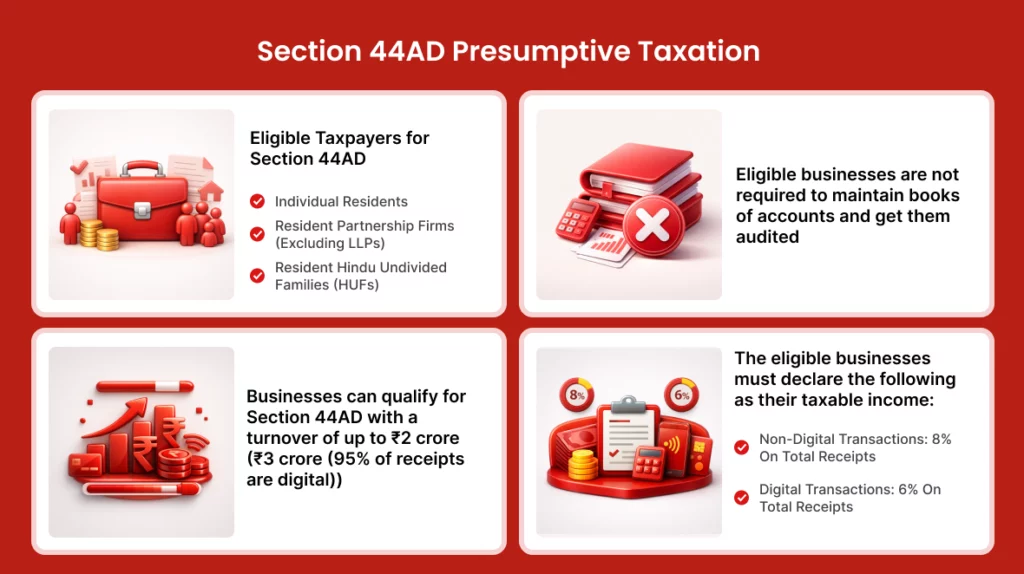
- Eligible businesses can declare 8% of turnover as income (6% for digital receipts)
- Turnover limit is ₹2 crore, or ₹3 crore if 95% of receipts are digital
- No need to maintain books of accounts or get a tax audit
- Once opted in, you must continue the scheme for 5 consecutive years
Introduction
For most small business owners in India, the hardest part of paying taxes is not the tax itself, it is the paperwork that comes with it. Maintaining detailed books of accounts, tracking every expense, can feel like a full-time job on top of running the business.
This is exactly the problem Section 44AD of Income Tax Act was designed to solve. It offers a presumptive taxation scheme that lets eligible small businesses declare their income at a fixed percentage of turnover, skip detailed bookkeeping, and file their returns using the simpler ITR-4 form.
This blog explains what Section 44AD is, who can use it, how presumptive income is calculated, and the key rules you should know before opting in.
What is Section 44AD of Income Tax Act?
Section 44AD is part of the presumptive taxation introduced by the Income Tax Act, 1961. Instead of calculating actual profit by subtracting every expense from every sale, eligible small businesses can simply declare a fixed percentage of their total turnover as their taxable income.
The idea is straightforward: reduce the compliance burden on small taxpayers who cannot afford the cost or time of maintaining formal books of accounts. You pay tax on a presumed profit, and the Income Tax Department accepts it without asking you to justify every rupee.
Running a GST-registered business also means keeping your sales and purchase records organised. A good accounting software for small businesses can help you track turnover accurately, which is the single most important number under Section 44AD.
Who is Eligible for Section 44AD?
The presumptive taxation scheme under Section 44AD is available only to specific categories of resident taxpayers.
Eligible:
- Resident Individuals
- Hindu Undivided Families (HUFs)
- Partnership Firms (excluding LLPs)
Not eligible:
- Taxpayers claiming deductions under Sections 10A, 10AA, 10B, 10BA, or Chapter VI-A (Part C)
- Limited Liability Partnerships (LLPs)
- Companies
- Non-resident taxpayers
Turnover Limit Under Section 44AD
The turnover limit depends on how much of your business is digital versus cash.
| Mode of Receipt | Turnover Limit |
| Cash receipts above 5% of total receipts | Up to ₹2 crore |
| Cash receipts up to 5% of total (95%+ digital) | Up to ₹3 crore |
The higher ₹3 crore limit was introduced to encourage digital payments. If your business runs mostly on UPI, bank transfers, and card payments, you get double the headroom.
Businesses Not Covered Under Section 44AD
Even if you meet the turnover limit, some businesses and professions are specifically excluded from Section 44AD:
- Businesses of plying, hiring, or leasing goods carriages (covered under Section 44AE)
- Agency business
- Persons earning income through commission or brokerage
- Specified professionals like doctors, lawyers, architects, CAs, engineers, interior decorators (they use Section 44ADA instead)
How Presumptive Income is Calculated
Under Section 44AD, your taxable business income is calculated as a fixed percentage of your turnover:
| Type of Receipt | Presumptive Income Rate |
| Cash receipts | 8% of turnover |
| Digital or banking channel receipts | 6% of turnover |
Note: Government wants to promote Digital Receipts by allowing lower tax rate.
Example: Rohan runs a retail store with a total turnover of ₹1 crore for FY 2025-26. Out of this, ₹80 lakh was received through UPI and bank transfers, and ₹20 lakh in cash.
- Presumptive income on digital receipts: 6% of ₹80 lakh = ₹4,80,000
- Presumptive income on cash receipts: 8% of ₹20 lakh = ₹1,60,000
- Total presumptive income: ₹6,40,000
Rohan will pay income tax on ₹6,40,000 as per the applicable slab, regardless of his actual profit or loss.
Important: You can voluntarily declare a higher income than the presumptive rate, but you cannot declare lower without triggering audit requirements.
Benefits of Opting for Section 44AD
- No books of accounts required under Section 44AA.
- No tax audit required under Section 44AB.
- Simpler ITR filing through Form ITR-4 (Sugam), not the complex ITR-3.
- All deductions under Sections 30–38 are deemed already claimed.
- Partnership firms can still deduct partner salary and interest within Section 40(b) limits.
Check Out – Avoiding Penalties: The Ultimate Guide to GST Return Filing Dates for SMEs
Key Rules You Must Know
The 5-Year Lock-in Rule
Once you opt into Section 44AD, you must continue the scheme for five consecutive assessment years. If you opt out before completing five years, you will be barred from using the presumptive scheme for the next five assessment years, and you must maintain regular books of accounts and get them audited.
Advance Tax Rule
Taxpayers under Section 44AD must pay 100% of their advance tax by 15 March of the financial year. Missing this deadline attracts interest under Section 234C.
ITR Filing
Returns must be filed using ITR-4 (Sugam), which is shorter and simpler than ITR-3. You only need to report gross turnover, presumptive income, and a few basic balance sheet figures like cash, debtors, and creditors.
Conclusion
Section 44AD is one of the most taxpayer-friendly provisions in the Income Tax Act for small businesses. It removes the heaviest compliance burdens, detailed bookkeeping and audits and replaces them with a simple percentage-based income declaration. If your business is eligible, opting for presumptive taxation can save you hours of paperwork and thousands of rupees in professional fees every year. Just remember the 5-year lock-in and the advance tax deadline, and keep your turnover records clean so that filing ITR-4 each year becomes a smooth, predictable task.


