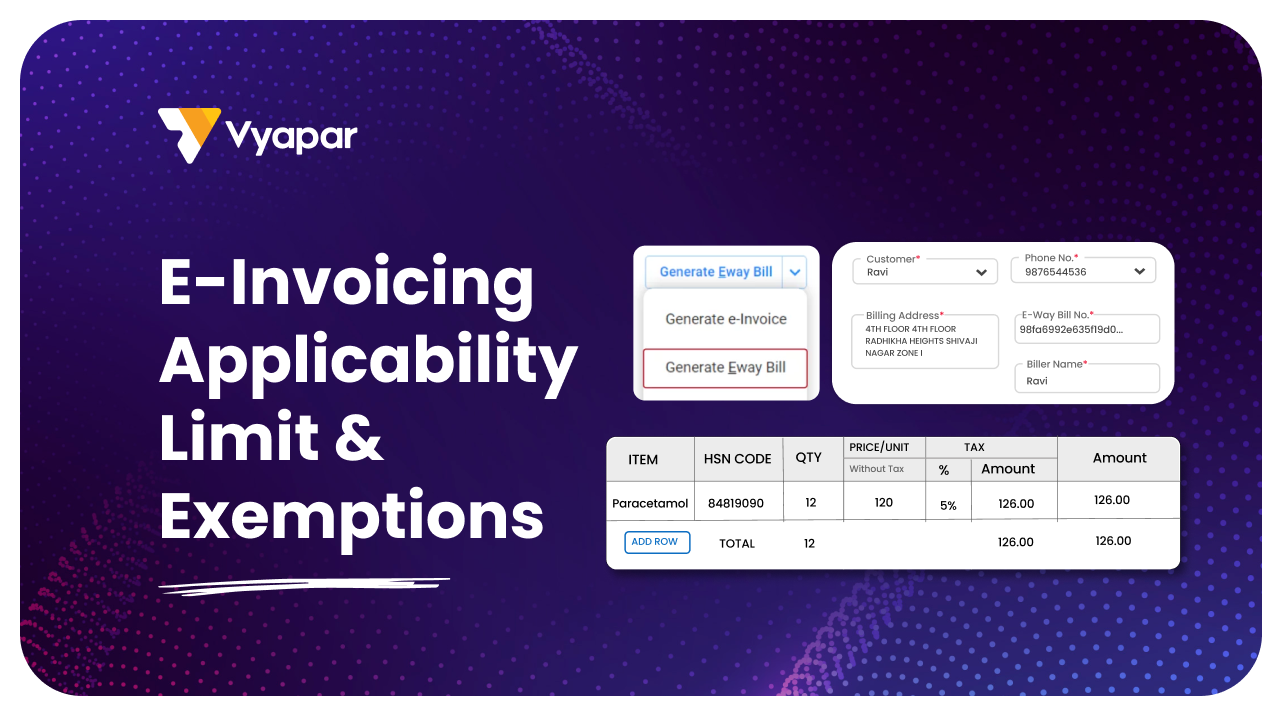
E-invoicing under GST is no longer a niche compliance meant only for large corporations. Over the years, the government has steadily expanded its scope, bringing thousands of mid-sized businesses into the system. Today, many owners first realise they’re covered only when their accountant says, “You need to generate IRNs now. ”Under Section 31 of the CGST Act, e-invoicing is a mandatory digital validation process for businesses meeting specific turnover thresholds. As of 2025, the current e-invoicing turnover limit is ₹5 crore, applicable to all B2B, B2G, and Export transactions. This blog explains who needs to follow e-invoicing today, what the current turnover limit is, which businesses are exempt, how IRN generation works, penalties for non-compliance, what’s happening with B2C e-invoicing, the latest April 2025 reporting deadlines, and exemptions for SEZs and Banks, all in plain, practical language.
What Is E-Invoicing?
E-invoicing does not mean uploading PDFs or scanning bills.
It means:
Before you issue a GST invoice to a registered customer, the key invoice details must be registered electronically with a government-approved system. Once registered, the invoice gets a unique ID called an IRN (Invoice Reference Number) and a QR code.
Only after this step is completed is the invoice considered valid under GST law.
Think of it like getting a boarding pass stamped before boarding a flight. The ticket exists, but without the stamp, it’s not officially accepted.
Why the Government Introduced E-Invoicing?
The goal is simple:
Reduce fake invoices
Stop incorrect ITC claims
Improve transparency
Make GST reporting more accurate
Reduce manual data entry
Once an invoice is registered, its data flows automatically into GST systems. This reduces mismatches between sales, purchases, and tax credits.
Current E-Invoicing Turnover Limit
E-invoicing applicability is based on aggregate annual turnover, calculated PAN-wise, not GSTIN-wise.
That means: If you have multiple GST registrations under one PAN, their turnover is combined.
Current rule
If your business exceeded this limit in any financial year from 2017-18 onwards, you are permanently covered under the mandate. Even if your current year’s turnover drops below ₹5 crore, you must continue generating IRNs.
It does not matter:
Which year you crossed it
Whether current year turnover is lower
Whether only one GSTIN crosses the limit
Once applicable, it stays applicable.
Criteria
Detail
AATO Limit
₹5 Crore
Calculation Basis
PAN-based (combined turnover of all GSTINs)
Mandatory From
August 1, 2023 (latest phase)
2025 Update
Mandatory 30-day reporting for AATO ≥ ₹10 Cr (effective April 1, 2025)
Evolution of E-Invoicing Limits
Phase
Turnover Threshold
Who Was Covered
Phase 1
₹500 crore
Very large corporates
Phase 2
₹100 crore
Large enterprises
Phase 3
₹50 crore
Upper mid-sized businesses
Phase 4
₹20 crore
Expanding MSME coverage
Phase 5
₹10 crore
Most organised businesses
Current
₹5 crore
Wide MSME coverage
This phased approach shows the clear intent: e-invoicing is becoming the norm, not the exception.
Which Businesses Must Generate E-Invoices?
E-invoicing is mandatory for eligible businesses when issuing invoices for:
Sales to GST-registered customers (B2B)
Supplies to government departments or entities
Exports
Debit notes and credit notes related to these transactions
If your customer is registered under GST and you cross the turnover limit, e-invoicing applies.
Which Businesses Are Exempt?
Even if turnover exceeds ₹5 crore, some categories are excluded.
Common exemptions include:
Banks and financial institutions
Insurance companies
NBFCs
Passenger transport services
Goods transport agencies (for specific documents)
SEZ units (not developers)
Businesses issuing only exempt or nil-rated supplies
These exemptions exist because certain industries operate on specialised billing or regulatory frameworks.
Is E-Invoicing Required for B2C Sales?
As of now, B2C e-invoicing is not mandatory.
That means: Invoices issued directly to unregistered customers do not require IRN generation.
However, discussions around high-value B2C transactions and future expansion have taken place. For now, businesses should stay alert but not panic.
Bottom line: B2B = Yes B2C = No (for now)
How IRN Generation Works?
Here’s how it happens in day-to-day business operations:
You create an invoice in your billing or accounting system
The system converts invoice data into a prescribed digital format
The data is sent to an Invoice Registration Portal
The portal validates the invoice
A unique IRN and QR code are generated
The invoice is returned with digital authentication
You issue the final invoice to the customer
Once IRN is generated:
The invoice data automatically flows into GST systems
Manual upload errors reduce drastically.
New Time Limit Rule You Must Know
A recent compliance tightening affects businesses with higher turnover.
If your aggregate turnover is ₹10 crore or more, invoices cannot be registered after 30 days from the invoice date.
This means:
Old or back-dated invoices will be rejected
Delays in IRN generation can invalidate invoices
This rule pushes businesses toward near-real-time invoicing, reducing misuse and late reporting.
Penalty for Non-Compliance (Why This Matters)
Failure to follow e-invoicing rules can be costly.
Possible consequences include:
Penalty equal to 100% of tax amount or ₹10,000 per invoice, whichever is higher
Additional penalty for incorrect invoicing
Problems during goods movement
ITC disputes with customers
Increased audit scrutiny
Example:
If you issue 200 invoices without IRNs when required, penalties apply per invoice, not once.
This is why businesses treat e-invoicing as a process issue, not a filing task.
Common Mistake
What Usually Goes Wrong
Practical Solution
Generating invoices first and IRNs later
Invoice becomes invalid if IRN is not generated before issue
Generate IRN first, then issue the final invoice to the customer.
Assuming turnover is GSTIN-wise instead of PAN-wise
Businesses wrongly believe only one registration counts
Calculate aggregate turnover PAN-wise across all GST registrations.
Forgetting debit and credit notes also require IRNs
Adjustments are issued without IRN, leading to non-compliance
Treat debit/credit notes exactly like invoices for IRN generation.
Missing the 30-day IRN reporting window
Older invoices get rejected by the IRP
Set internal deadlines to generate IRNs within a few days of invoicing.
Believing e-invoicing replaces GST returns
GSTR-1 or GSTR-3B filing gets delayed or skipped
Continue filing GST returns; e-invoicing only feeds data, it doesn’t replace returns.
Claiming exemption without verification
Business assumes it’s exempt but actually isn’t
Confirm exemption eligibility from official GST/IRP guidelines before skipping IRNs.
Issuing manual invoices during system downtime
Offline invoices issued without later IRN generation
Generate IRN immediately once systems are restored and avoid prolonged offline billing.
Not training billing staff on e-invoicing workflow
Staff issues invoices without IRN due to process gaps
Conduct basic staff training and create a simple invoicing SOP.
Ignoring IRN rejection errors
Validation errors cause IRN failure but invoices are still shared
Resolve errors immediately and regenerate IRN before sending invoices.
Using incorrect invoice numbering format
Duplicate or invalid invoice numbers lead to IRN rejection
Maintain a consistent, unique invoice numbering series.
Not reconciling e-invoices with GSTR-1
Mismatches appear in GST returns
Reconcile e-invoices and GSTR-1 every month before filing.
Assuming B2C invoices also need IRNs
Unnecessary compliance effort and confusion
Apply e-invoicing only to B2B/B2G/export invoices unless notified otherwise.
Avoiding these mistakes saves money and effort.
Does E-Invoicing Replace GSTR-1 or GSTR-3B?
No. E-invoicing supports GST returns but does not replace them.
GSTR-1 still needs to be filed
GSTR-3B still determines tax payment
E-invoicing simply ensures cleaner data
Think of it as automatic data feeding, not return filing.
How to Stay Compliant Without Stress
Here’s a simple checklist:
Confirm turnover eligibility every year
Enable IRN generation in your billing system
Generate IRN before issuing invoices
Train staff on revised workflow
Reconcile invoices monthly
Monitor updates regularly
Businesses using integrated accounting tools find this far easier than manual methods.
What This Means for Growing Businesses?
If your business is nearing ₹5 crore turnover, e-invoicing should be planned before you cross the limit.
Early preparation avoids:
Sudden operational disruption
Customer complaints
Penalties
Last-minute software changes
E-invoicing isn’t just compliance. It’s becoming standard infrastructure for GST.
Conclusion
E-invoicing is no longer a niche compliance limited to large corporations. With the turnover limit now at ₹5 crore, it has become a regular part of billing for a wide range of growing businesses. Most problems around e-invoicing don’t come from complex rules, but from small process gaps, generating invoices before IRNs, missing timelines, or misunderstanding applicability.
The key is building e-invoicing into your daily billing flow instead of treating it as an extra task at month-end. When invoicing, IRN generation, and GST reporting happen together, compliance becomes predictable and stress-free. This is where using a single system that handles billing, e-invoicing, and GST returns together like Vyapar, quietly simplifies things. It reduces manual steps, avoids last-minute errors, and helps businesses stay aligned with evolving GST rules without needing constant follow-ups.
Handled the right way, e-invoicing stops feeling like a compliance burden and becomes just another smooth step in running a compliant business.
To simplify compliance and avoid manual errors, many businesses are now switching to E-invoicing System Software. It helps generate invoices, create IRNs in real time, and keep all billing data aligned with GST requirements in one seamless flow.
Frequenetly Asked Questions (FAQs)
Once e-invoicing becomes applicable, can it ever stop applying to my business?
No. If your aggregate turnover crosses the prescribed limit in any financial year, e-invoicing continues to apply even if turnover falls below the limit in later years.
Does e-invoicing apply to advances received from customers?
No. E-invoicing is required for tax invoices, debit notes, and credit notes not for advance receipts. However, final invoices raised against advances must follow e-invoicing rules if applicable.
Can I cancel an e-invoice after generating the IRN?
Yes, but only within the allowed cancellation window. Once cancelled, the same invoice number cannot be reused, and fresh IRN generation is required for a new invoice.
Is IRN generation required for delivery challans?
No. Delivery challans do not require IRN generation. E-invoicing applies only to specified tax documents like invoices and debit/credit notes.
What happens if my customer refuses an invoice because IRN is missing?
The customer is right to do so. An invoice requiring e-invoicing but issued without IRN is considered invalid and may cause ITC denial for the buyer.
I'm a Chartered Accountant with 13+ years of experience in finance, taxation, and MSME consulting. I worked with leading industries and with the Vyapar Group, helping businesses simplify their accounting and financial operations.
Designation: Chartered Accountant, FCA
Membership Number (MRN): 418428
City: Raipur, C.G
KEY TAKEAWAYS GST 2.0 introduced a simplified tax structure with major slabs reduced to 0%, 5%, 18%, and 40% from 22 September 2025 The old 12% and 28% GST slabs were largely removed, with items shifted either to 5%, 18%, or 40% Daily essentials like soap, shampoo, butter, ghee, namkeen, notebooks, and insurance became significantly…
KEY TAKEAWAYS Section 44AD offers a presumptive taxation scheme for small businesses to simplify ITR filing Eligible businesses can declare 8% of turnover as income (6% for digital receipts) Turnover limit is ₹2 crore, or ₹3 crore if 95% of receipts are digital No need to maintain books of accounts or get a tax audit…
Introduction As the financial year draws to a close, many business owners feel they’ve missed the window for tax planning. In reality, there’s still time to make a few smart financial decisions before March 31 that can reduce your tax liability for FY 2025-26. For SMEs, proprietors, and professionals, year-end tax planning isn’t about complicated…