Cheaper vs Better: Choosing Accounting Software for the New Financial Year
Introduction
Every new financial year brings the same question for small business owners:
“Should I continue with what I have, or upgrade to something better?”
For many shop owners, traders, and first-time entrepreneurs, accounting software is often chosen the same way we choose a calculator. Whatever is cheaper or easily available. But here’s the thing. Accounting software is not just a cost. It’s a business decision.
Let’s break this down simply from a real small-business point of view..
Why Choosing the Right Accounting Software Matters More Than Ever
Running a small business in India today is very different from 5 or 10 years ago.
You are dealing with:
- GST compliance
- E-invoicing (for some businesses)
- Inventory tracking
- Credit sales and outstanding payments
- Price fluctuations
- Thin margins
- Customer expectations for proper bills
Manual registers or half-baked software might work initially. But as your business grows, mistakes become expensive.
A wrong GST entry, missed ITC, Untracked stock, and forgotten receivables. These don’t show up immediately, but they quietly eat into profits.This is why choosing the best accounting software at the start of the financial year can make the entire year run more smoothly.
Cheaper Accounting Software: What It Usually Means
Let’s be honest. Many small businesses choose software because it’s cheap or even free. On the surface, it appears to be a smart decision. But what does “cheap” usually come with?
Common Features of Cheaper Accounting Software
- Basic billing only
- Limited GST support
- No proper inventory tracking
- Manual data entry
- Poor reports
- No local support
- Complicated setup
- Frequent errors
For a kirana store or small trader, this may seem manageable at first.
But here’s where problems start.
Real-World Example
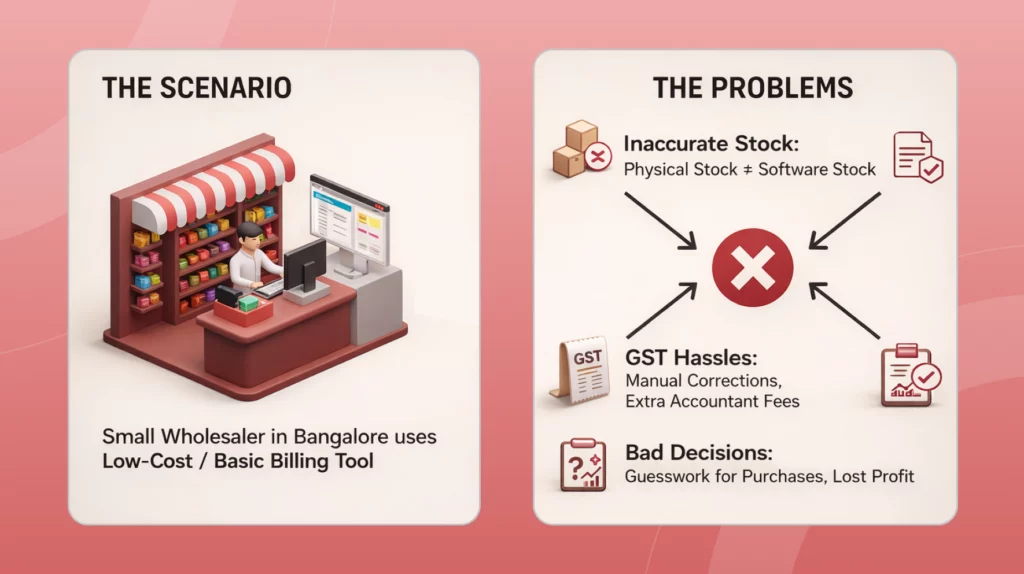
A small wholesaler in Bangalore uses a low-cost billing tool.
Bills are generated, but the stock is not linked properly.
At month’s end:
- Physical stock doesn’t match software stock
- GST returns need manual correction
- Accountant charges extra to fix errors
- Purchase decisions are based on guesswork
The software was cheap. The mistakes were not.
Better Accounting Software: What You’re Actually Paying For
Better does not always mean expensive. It means useful, reliable, and designed for your type of business. A good accounting software for small businesses helps you see the full picture.
What Better Accounting Software Typically Offers
- Easy billing with GST
- Automatic stock updates
- Customer and supplier tracking
- Outstanding reports
- GST summaries
- Simple reports you can understand
- Works on mobile and desktop
- Reliable data backup
- Support when you’re stuck
This is not about fancy features. It’s about control and clarity.
Check out – Top Features and Benefits of Accounting Software
Cheaper vs Better: Side-by-Side Comparison
| Aspect | Cheaper Accounting Software | Better Accounting Software |
| Initial Cost | Low or free | Slightly higher |
| Billing | Basic | GST-ready, professional |
| Inventory Tracking | Manual or limited | Automatic, real-time |
| GST Compliance | Partial or manual | Built-in summaries |
| Reports | Confusing or missing | Simple and useful |
| Error Handling | User responsible | Software assists |
| Support | Email only or none | Phone/chat/local help |
| Scalability | Limited | Grows with business |
| Peace of Mind | Low | High |
When you view it in this way, the question changes.
It’s no longer “Which is cheaper?” It becomes “Which saves me time, money, and stress?”
Why Small Businesses Struggle With Accounting (And It’s Not Your Fault)
Most Indian small business owners are not accountants. And they shouldn’t have to be.
Your strength is:
- Buying smart
- Selling well
- Managing customers
- Negotiating prices
- Running daily operations
Accounting should support this, not complicate it.
Problems arise when:
- Software is built for accountants, not shop owners
- Language is too technical
- Reports don’t make sense
- Simple tasks need expert help
This is why many businesses avoid checking reports until tax time. And that’s risky.
What This Really Means for the New Financial Year
The new FY is the best time to fix weak systems.
If you continue with poor bookkeeping:
- Errors get carried forward
- Opening balances go wrong
- Stock mismatches increase
- GST notices become more likely
But if you start fresh with good bookkeeping software, you get:
- Clean opening data
- Better control from day one
- Easier GST filing
- Clear profit visibility
This one decision impacts the entire year.
Explore – How to Close Books of Accounts
What to Look for in Small Business Accounting Software
Before choosing any accounting platform, ask yourself these simple questions.
1. Can I Use It Without an Accountant Sitting Next to Me?
If the answer is no, it’s not meant for you.
Good software should allow you to:
- Make bills easily
- Check stock
- See outstanding payments
- Understand basic financial reports
2. Does It Handle GST Without Confusion?
GST is non-negotiable.
Your software should:
- Calculate GST automatically
- Separate CGST, SGST, IGST
- Give GST summaries
- Reduce manual errors
3. Can I Track Stock Without Guesswork?
Stock is money lying on shelves.
Good bookkeeping software for small businesses:
- Updates stock on every sale
- Tracks purchase vs sale quantity
- Shows fast-moving and slow-moving items
- Helps plan reorders
Explore – How automated bookkeeping works?
4. Does It Help Me Collect Payments?
Many businesses lose cash due to poor tracking.
Better accounting software shows:
Follow-up reminders
Customer outstanding
Supplier dues
Ageing reports
How All-in-One Accounting Software Helps Small Shops Grow
Here’s the thing most people miss. Growth does not come only from higher sales.
It comes from better control. An all-in-one accounting platform brings billing, stock, GST, and reports under one roof.
Benefits for Small Shops
- Less dependency on accountants for daily work
- Faster billing at the counter
- Reduced stock losses
- Fewer GST mistakes
- Better cash flow tracking
- Accurate numbers
This allows shop owners to focus on business, not paperwork.
India-Specific Challenges That Software Must Handle
Indian small businesses are unique.
Your software must understand:
- GST rules
- List of HSN codes
- Credit sales culture
- Local language comfort
- Mobile-first usage
- Low internet scenarios
Many international tools fail here.
They look good, but don’t fit the Indian ground reality.
That’s where platforms designed for Indian MSMEs make a difference.
Where Vyapar Fits In (Without the Sales Talk)
Vyapar is built keeping Indian small businesses in mind.
It focuses on:
- Simple billing
- GST compliance
- Inventory control
- Mobile and desktop usage
- Clear automated reports
The reason many kirana stores, traders, and retailers adopt Vyapar is not that it’s fancy.
It’s because it’s practical.
It shows the full picture so business owners can plan GST liability, understanding P&L statement, and avoid surprises. No hype. Just clarity.
Common Mistake: Choosing Software Only Based on Price
Let’s say you save ₹3,000 on software.
But due to:
- Wrong GST entries
- Missed ITC
- Stock mismatch
- Accountant corrections
You lose ₹20,000 over the year. Was the software actually cheaper?
This happens more often than people admit.
Best Accounting Software Is the One That Fits Your Business
There is no single “best” software for everyone.
But the best accounting software for small businesses will:
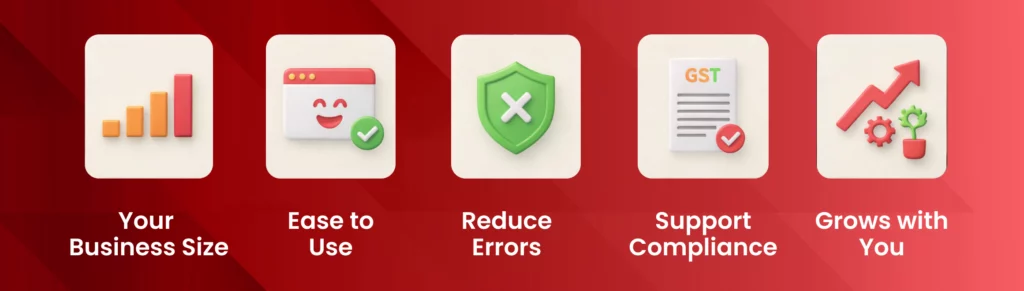
- Match your business size
- Be easy to use
- Reduce errors
- understand basic financial statements
- Support compliance
- Grow with you
Cheapest is rarely best. The most expensive is unnecessary. The right fit is what matter
How to Decide Before the New FY Starts
Here’s a simple action plan.
- List your daily problems.
- Identify where errors happen.
- Check if your current software solves them
- Try a better alternative if needed
- Start the new FY with clean data
This one change can reduce stress for the entire year.
Final Thoughts: Future-Ready Small Shops
Small businesses today are no longer small in ambition.
You want:
- Stability
- Predictable cash flow
- Fewer compliance issues
- Time to grow
Accounting software plays a silent but powerful role in this. Choosing better over cheaper is not about spending more. It’s about running your business smarter. Start the new financial year with tools that work for you, not against you. Your future self will thank you.
Frequently Asked Questions (FAQs)
Is cheaper accounting software always a good choice for small businesses?
Not necessarily. Cheaper software may handle basic billing, but often lacks features for GST compliance, inventory tracking, or reports. Over time, the cost of errors, manual work, and missed compliance can be higher than the software price itself.
Should first-time business owners avoid free or basic software?
Free or basic software is fine when you’re just starting. But once transactions increase, relying on limited tools can create data gaps and compliance risks. The new financial year is a good time to shift to software that can grow with your business.
How does the Vyapar software help in financial planning?
When sales, expenses, and ITC are tracked in one place using tools like the Vyapar App, businesses get a clearer picture of profits and GST liability in advance. This makes planning for taxes, cash flow, and expenses far more predictable.
Is accounting software necessary if my CA already handles GST?
Yes. Your CA files return, but you run the business daily. Software helps you track sales, expenses, and cash flow in real-time, allowing you to make informed decisions instead of waiting for monthly updates.
What’s the risk of switching software every year?
After 24 hours, cancellation is not allowed on the IRP. You must issue a credit note to adjust or reverse the transaction.