Every new financial year brings the same question for small business owners: “Should I continue with what I have, or upgrade to something better?”
For many shop owners, traders, and first-time entrepreneurs, accounting software is often chosen the same way we choose a calculator. Whatever is cheaper or easily available. But here’s the thing. Accounting software is not just a cost. It’s a business decision.
Let’s break this down simply from a real small-business point of view..
Why Choosing the Right Accounting Software Matters More Than Ever
Running a small business in India today is very different from 5 or 10 years ago.
You are dealing with:
GST compliance
E-invoicing (for some businesses)
Inventory tracking
Credit sales and outstanding payments
Price fluctuations
Thin margins
Customer expectations for proper bills
Manual registers or half-baked software might work initially. But as your business grows, mistakes become expensive.
A wrong GST entry, missed ITC, Untracked stock, and forgotten receivables. These don’t show up immediately, but they quietly eat into profits.This is why choosing the best accounting software at the start of the financial year can make the entire year run more smoothly.
Cheaper Accounting Software: What It Usually Means
Let’s be honest. Many small businesses choose software because it’s cheap or even free. On the surface, it appears to be a smart decision. But what does “cheap” usually come with?
Common Features of Cheaper Accounting Software
Basic billing only
Limited GST support
No proper inventory tracking
Manual data entry
Poor reports
No local support
Complicated setup
Frequent errors
For a kirana store or small trader, this may seem manageable at first.
But here’s where problems start.
Real-World Example
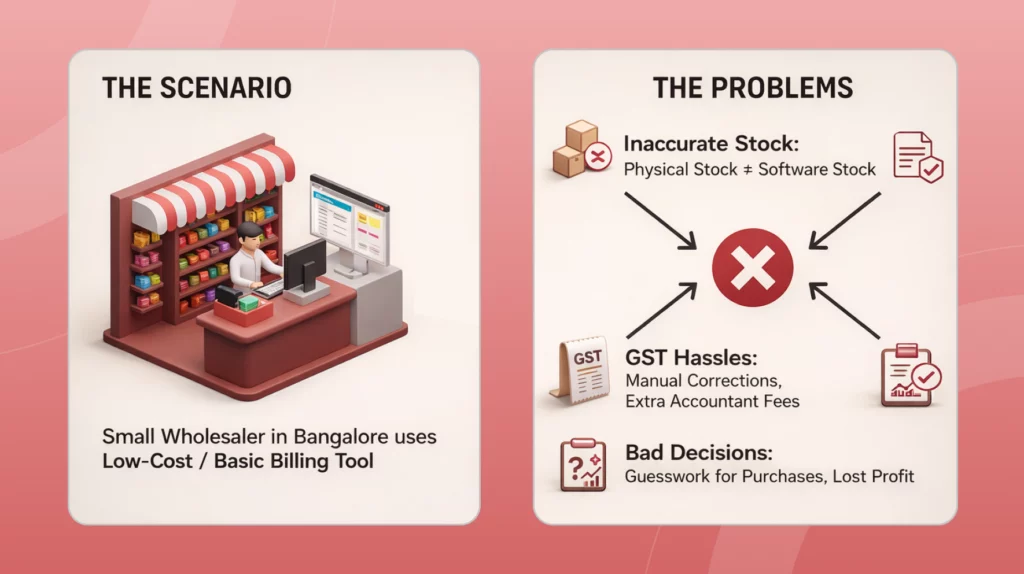
A small wholesaler in Bangalore uses a low-cost billing tool. Bills are generated, but the stock is not linked properly.
At month’s end:
Physical stock doesn’t match software stock
GST returns need manual correction
Accountant charges extra to fix errors
Purchase decisions are based on guesswork
The software was cheap. The mistakes were not.
Better Accounting Software: What You’re Actually Paying For
Better does not always mean expensive. It means useful, reliable, and designed for your type of business. A good accounting software for small businesses helps you see the full picture.
How All-in-One Accounting Software Helps Small Shops Grow
Here’s the thing most people miss. Growth does not come only from higher sales. It comes from better control. An all-in-one accounting platform brings billing, stock, GST, and reports under one roof.
Benefits for Small Shops
Less dependency on accountants for daily work
Faster billing at the counter
Reduced stock losses
Fewer GST mistakes
Better cash flow tracking
Accurate numbers
This allows shop owners to focus on business, not paperwork.
India-Specific Challenges That Software Must Handle
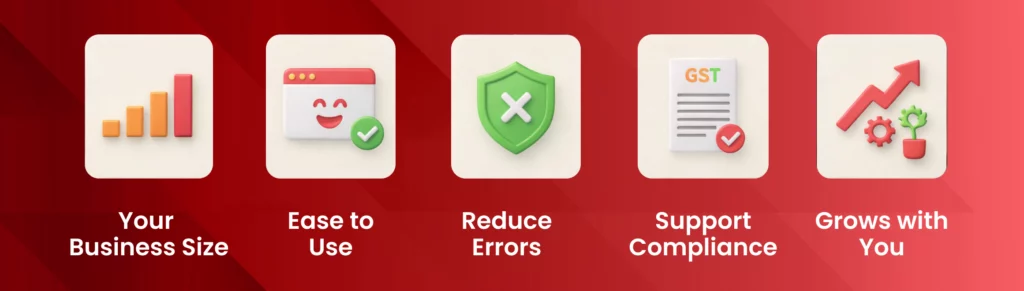
Cheapest is rarely best. The most expensive is unnecessary. The right fit is what matter
How to Decide Before the New FY Starts
Here’s a simple action plan.
List your daily problems.
Identify where errors happen.
Check if your current software solves them
Try a better alternative if needed
Start the new FY with clean data
This one change can reduce stress for the entire year.
Final Thoughts: Future-Ready Small Shops
Small businesses today are no longer small in ambition.
You want:
Stability
Predictable cash flow
Fewer compliance issues
Time to grow
Accounting software plays a silent but powerful role in this. Choosing better over cheaper is not about spending more. It’s about running your business smarter. Start the new financial year with tools that work for you, not against you. Your future self will thank you.
Frequently Asked Questions (FAQs)
Is cheaper accounting software always a good choice for small businesses?
Not necessarily. Cheaper software may handle basic billing, but often lacks features for GST compliance, inventory tracking, or reports. Over time, the cost of errors, manual work, and missed compliance can be higher than the software price itself.
Should first-time business owners avoid free or basic software?
Free or basic software is fine when you’re just starting. But once transactions increase, relying on limited tools can create data gaps and compliance risks. The new financial year is a good time to shift to software that can grow with your business.
How does the Vyapar software help in financial planning?
When sales, expenses, and ITC are tracked in one place using tools like the Vyapar App, businesses get a clearer picture of profits and GST liability in advance. This makes planning for taxes, cash flow, and expenses far more predictable.
Is accounting software necessary if my CA already handles GST?
Yes. Your CA files return, but you run the business daily. Software helps you track sales, expenses, and cash flow in real-time, allowing you to make informed decisions instead of waiting for monthly updates.
What’s the risk of switching software every year?
After 24 hours, cancellation is not allowed on the IRP. You must issue a credit note to adjust or reverse the transaction.
Varsha K Vijay is a finance professional with over five years of experience in accounting, GST compliance, and financial operations. She has cleared the CA Foundation and her work spans GST filing, TDS compliance, MIS reporting, and financial content writing.
Introduction Retail businesses today need much more than basic bookkeeping. Between GST compliance, inventory valuation, expense tracking, profit monitoring, vendor payments, and daily sales reconciliation, managing finances has become increasingly complex.. To help retailers choose the right solution, I’ve compared five of the most popular accounting software options in India based on ease of use,…
Introduction Running a small business in India in 2026 means going through GST returns, e-invoicing, e-way bills, inventory, and daily bookkeeping, usually without a full-time accountant. The right GST accounting software for small business automates the heavy lifting and frees you to focus on growth. We’ve compared the five most widely used names in India,…
KEY TAKEAWAYS Form 16 is a TDS certificate issued by your employer showing salary income and tax deducted during the financial year It has two parts: Part A (TDS summary) and Part B (detailed salary breakup and deductions) Employers must issue Form 16 by 15 June after the end of the financial year You can…