Start date is 15 October 2026: Not 1 April. Messages circulating about an April rollout are wrong
The rate is 0.4%: On P2M UPI payments above Rs 2,000, capped at Rs 300 per transaction
Small shops pay nothing: Merchants in the P2PM category receiving up to Rs 1 lakh a month have zero MDR on every payment, whatever the size
Below Rs 2,000 is free for everyone: These make up over 95% of all UPI merchant transactions
Flat Rs 5 for some sectors: Railways, telecom, insurance, fuel, and utility bills above Rs 2,000 pay a fixed Rs 5 per transaction
Mutual funds and brokers pay 0.02%: Also capped at Rs 300
You cannot add it to the customer’s bill: NPCI has barred merchants from passing MDR on to buyers
No change to your QR code: No new standee, no re-registration, no bank visit
AutoPay stays free: UPI Mandates carry no prescribed MDR
What is the new UPI MDR charge for merchants?
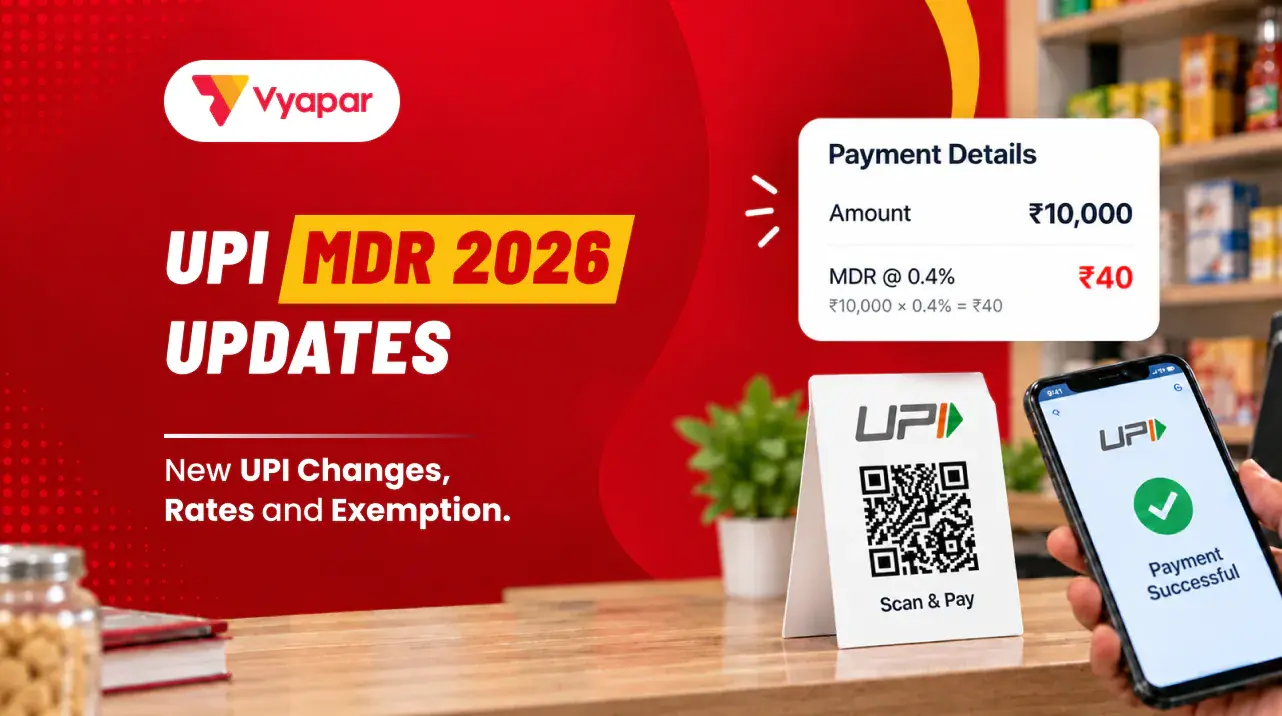
From 15 October 2026, a 0.4% MDR applies to Person-to-Merchant (P2M) UPI transactions above Rs 2,000, with a maximum of Rs 300 per transaction on payments of Rs 75,000 and above. Small merchants under the P2PM category, all payments up to Rs 2,000, and all person-to-person transfers remain free.
What is UPI MDR in simple words?
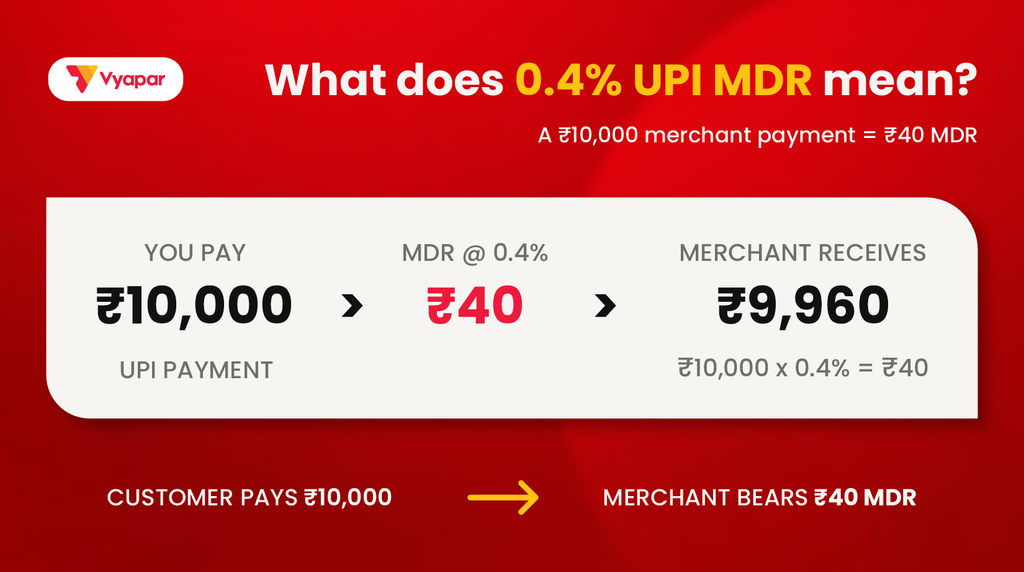
MDR stands for Merchant Discount Rate. It is a small fee a business pays for accepting a digital payment. The fee is cut before the money reaches your account, so your bank credit will be slightly less than the bill amount. This is not new in India. Credit cards carry 1.5% to 2.5%. Debit cards go up to 0.90%. UPI has been free for merchants until now.
It is also worth being clear about what MDR is not. NPCI has stated that MDR is not a tax and the government does not collect it. The money is shared among the banks, payment service providers, and apps that run the payment, and NPCI says it will go towards infrastructure, cybersecurity, innovation, and customer service. A Finance Ministry clarification has confirmed that the charge sits inside the merchant payment ecosystem and will not be levied on customers.
The ₹300 cap is important for large transactions. For example, 0.4% of ₹1,00,000 is ₹400, but the MDR stops at ₹300. Note: The MDR rates are exclusive of GST as applicable. Current tax reporting indicates that 18% GST is charged on the MDR itself, not on the entire UPI payment value.
Will Customers Have to Pay UPI Charges?
No. The new MDR is a merchant-side charge. Customers will continue to make UPI payments without paying MDR, and person-to-person UPI transactions remain free regardless of the amount transferred.
Payments made to merchants of up to ₹2,000 also remain free under the new framework. Eligible transactions covered by the zero-MDR small-merchant framework remain free as well. Merchants cannot add the MDR as a separate charge to the customer’s bill.
Who Will Pay UPI MDR? P2PM and P2M Impact explained
This is where the P2PM vs P2M distinction becomes important.
– P2PM (Peer-to-Peer-Merchant): Small Merchants
P2PM refers to the zero-MDR framework for eligible small merchants. These are small vendors who receive UPI payments through a QR code directly into their own personal bank account, up to Rs 1 lakh per month. They pay zero MDR on every transaction.
This is worth repeating clearly, because it is the most misunderstood part of the rule. If you are in the P2PM category and a customer pays you Rs 8,000, you still pay nothing. The Rs 2,000 threshold does not apply to you at all. GST registration is not required to stay in this category either. Eligibility depends only on your monthly collections and your account type.
– P2M (Peer-to-Merchant): Regular Merchants
P2M refers to regular commercial merchant transactions Eligible P2M UPI payments above ₹2,000 are subject to the applicable MDR. For the standard category, that means 0.4%, capped at ₹300 per transaction.
So, the amount of a single payment alone does not tell you whether you will pay MDR. Your merchant classification matters too.
What happens when you cross Rs 1 lakh a month?
Crossing ₹1 lakh in one month does not necessarily mean an immediate switch from P2PM to P2M.
Under the current NPCI framework, a P2PM merchant whose inward UPI collections remain above ₹1 lakh for three consecutive months can be transitioned to P2M.
Festival season is where this gets real. A shop that normally collects Rs 90,000 a month might do Rs 1.3 lakh through October, November, and December. Three strong months in a row is exactly the pattern that moves a merchant account across.
The right response is not to hold your business back. The amount involved is small. What matters is knowing the change is coming, so a lower bank credit in January does not look like a mistake.
What it actually costs, bill by bill
Bill amount
MDR you pay
Credited to your account
Rs 800
Rs 0
Rs 800
Rs 1,900
Rs 0
Rs 1,900
Rs 2,500
Rs 10
Rs 2,490
Rs 12,000
Rs 48
Rs 11,952
Rs 45,000
Rs 180
Rs 44,820
A garment shop doing 30 bills a month above Rs 2,000, averaging Rs 6,000 each, pays about Rs 720 a month. A hardware shop doing Rs 4 lakh a month in large bills pays about Rs 1,600.
The small merchant exemption is tied to your classification and threshold, not simply to being a small shop.
Which businesses pay a flat Rs 5 instead of 0.4%?
Some sectors have been kept on a fixed fee because their bills are large or their margins are thin. For payments above Rs 2,000, these pay a flat Rs 5 per transaction, whatever the amount:
Railways and telecom services
Insurance premium payments
Fuel purchases at petrol pumps
Utility bills such as electricity, municipal water, and piped natural gas
So a Rs 40,000 insurance premium costs the insurer Rs 5, not Rs 160. Below Rs 2,000, all of these remain free. These flat-rate categories together make up 17% of volume, 46% of value in UPI merchant transactions, so a large share of high-value UPI traffic is not paying 0.4% at all.
Capital markets are separate again. Mutual funds, SEBI-registered stockbrokers, securities dealers, and investment platforms pay 0.02%, capped at Rs 300. A Rs 10,000 mutual fund purchase costs the platform about Rs 2.
Education fees fall under the industry programme category with flat or capped rates rather than the full 0.4%. School and college fees up to Rs 2,000 stay completely free.What this MSME Development (Amendment) Bill Means for Small Businesses?
What Will Change for Merchants From 15 October 2026?
1. Your bank credit may be lower than the bill amount
Suppose you bill a customer ₹5,000. Under the standard MDR structure, the MDR is ₹20 and 18% GST on that MDR is ₹3.60, making the total MDR-related charge ₹23.60 before any eligible input tax credit. The exact settlement treatment can depend on the payment provider and applicable tax treatment.
2. MDR cannot be added as a separate customer charge
Merchants cannot simply add a UPI MDR line to the customer’s bill. The charge is borne within the merchant payment ecosystem. [Source: Ministry of Finance/PIB, 15 Sep 2026]
3. Reconciliation becomes more important
When the gross invoice value and bank settlement differ, businesses need a clear record of: Sales → UPI payment → MDR → GST on MDR → Bank credit
This is particularly important for businesses handling a large number of higher-value UPI payments.
What stays free under the new UPI rules?
Most of UPI is untouched by this change. Here is what carries no charge at all.
UPI payments made by consumers
UPI remains free for every consumer, with no monthly quota and no volume limit on free transactions. The daily limits your bank applies, usually Rs 1 lakh to Rs 5 lakh, are security measures, not fee slabs.
Person 2 Person transfers stay free
Sending money to family, splitting a bill with friends, or moving money between your own linked accounts costs nothing, for the sender and the receiver.
UPI AutoPay and mandates
Recurring payments set up through UPI Mandates, such as subscriptions, SIPs, or monthly bills, have no prescribed charge.
Credit on UPI is separate.
RuPay credit cards linked to UPI and pre-sanctioned credit lines follow standard credit card rules, not this 0.4%. If a customer pays you through credit on UPI, your cost will be the usual card rate, which is higher.
Merchant payments up to ₹2,000
Payments of up to ₹2,000 remain free of MDR.
Do Merchants Need to Change Their UPI QR Code?
No. Existing QR codes and soundboxes can continue to be used. Merchants do not need a new QR standee or re-registration simply because of the MDR update.
Your bank or payment provider should be the first point of contact for confirming how your merchant account is classified and how settlement deductions will appear.
What Should Shop Owners Do Before 15 October 2026?
Check your merchant category
Ask your bank or payment provider whether your UPI acceptance account is classified as P2PM or P2M. This can tell you whether the zero-MDR small-merchant framework or the applicable P2M MDR structure applies to your account.
Review your monthly UPI collections
If your business is close to the ₹1 lakh P2PM threshold, keep track of monthly inward UPI credits. The three-month classification rule makes this particularly relevant for growing shops. [Source: NPCI FAQ, 15 Sep 2026]
Start tracking payment deductions
Record MDR separately from the sale amount so your books match your bank statement.
Check the GST treatment
Where applicable, record GST on MDR separately and keep the required documents for accounting and ITC purposes. [Source: Business Standard]
Do not add MDR to the customer’s bill
The MDR is a merchant-side payment cost and should not be passed to the customer as a separate UPI surcharge.
Why has NPCI brought this in?
NPCI says the money collected from UPI charges will stay within the UPI system. It will fund infrastructure, cybersecurity, fraud detection, and customer support. Running UPI is estimated to cost around ₹20,000 crore a year, which has largely been covered by government subsidies so far. NPCI has said this subsidy is meant to be a short-term solution, not a permanent one.
The huge scale of UPI also explains these costs. In August 2026 alone, UPI processed 2,451 crore transactions worth ₹29.9 lakh crore. According to PIB’s UPI review, annual UPI transactions grew from 2 crore in FY 2016–17 to over 24,162 crore in FY 2025–26, with 703 banks now part of the network.
A separate fund will also be created from these charges to improve digital payment infrastructure in Tier 3 to Tier 6 cities, the Northeast, Jammu & Kashmir, and Ladakh. It will also support schemes such as PM SVANidhi and PM Vishwakarma. The detailed rules will be finalised with the RBI over the next three months. Any further updates will be shared through NPCI’s UPI circulars.
For businesses that receive many UPI payments, the main challenge is keeping track of the difference between the amount billed and the amount settled.
Vyapar’s GST billing software in India brings billing, accounting, payment records, inventory, and GST-related business records together in one place. This can help businesses keep organised records and reconcile sales with actual payment collections.
The software does not remove UPI MDR. What it can do is help businesses maintain better records of invoices and payment entries, making it easier to identify deductions and keep accounts accurate.
A Personal Note from the Founder
“UPI has changed the way millions of Indian businesses accept payments. For small businesses, its biggest strength has always been simplicity, a customer scans a QR code, the payment is completed, and the business gets paid instantly.
The introduction of MDR changes part of that equation, but it does not change the larger role UPI plays in digital payments. For most small merchants, especially those covered under the P2PM framework, the impact will remain limited. For businesses that do pay MDR, the bigger shift will be in how they track and reconcile their payments.
As businesses grow, even a small deduction on each transaction can become difficult to manage if it is not recorded properly. This is why billing, payments and accounting need to work together. The goal should not simply be to accept digital payments, but to have a clear view of what was billed, what was received and what was deducted.
At Vyapar, we believe digital tools should make payments and business management simpler for small businesses. No matter how the payment ecosystem changes, business owners should have clear visibility into their numbers so they can track payments, understand cash flow, and make informed decisions
FAQ’s on UPI MDR 2026
Will UPI charges apply on money sent to family or friends?
Still free
No, nothing changes here. Person-to-person transfers stay free for both the sender and the receiver, and that includes moving money between your own bank accounts.
So paying rent, splitting a dinner bill, or sending money home works exactly the way it does today.
Do I have to pay MDR if I run a small kirana shop?
Zero MDR
Most likely not. If your account sits in the P2PM category, which covers merchants receiving up to Rs 1 lakh a month through a UPI QR, your MDR is zero.
In this category even a single Rs 10,000 payment carries no charge. The size of the payment does not matter, only your monthly collection band does.
My customer paid me Rs 5,000. Am I charged?
Depends on category
It depends entirely on how your account is classified. If you are in the P2M category, the charge is 0.4%, which works out to Rs 20 on a Rs 5,000 payment.
If you are in P2PM, the charge is zero. Same payment, two very different outcomes, which is why checking your category is worth five minutes.
When will the new UPI MDR charges start?
Key date
The new framework is scheduled to take effect from 15 October 2026.
If you have seen forwards claiming a 1 April start, ignore them. That date is wrong and has been circulating on WhatsApp for months.
Will customers have to pay for UPI?
Still free
No. UPI stays free for consumers on person-to-person payments, and customers are not charged MDR when they pay a merchant either.
MDR is a merchant-side charge. Your buyer’s app will show the same amount they always saw.
Is UPI free for payments up to Rs 2,000?
Zero MDR
Yes. Merchant UPI payments up to Rs 2,000 stay free of MDR under the new framework.
This is a bigger relief than it sounds, because these small-ticket payments make up over 95% of all UPI merchant transactions.
What is the standard UPI MDR rate in 2026?
Rate
For eligible P2M transactions above Rs 2,000, the standard MDR is 0.4%, capped at Rs 300 per transaction.
The cap kicks in around the Rs 75,000 mark, so a Rs 2 lakh payment and a Rs 75,000 payment attract the same Rs 300 ceiling.
Will every shop pay 0.4% on UPI payments above Rs 2,000?
Not universal
No. Eligible P2PM small merchants covered by the zero-MDR framework can keep receiving UPI payments without MDR, subject to the applicable conditions.
The 0.4% rate applies to P2M accounts. It is a category rule, not a blanket rule.
What happens if my monthly UPI collections cross Rs 1 lakh?
Category shift
One good month will not move you. Under the current framework, a P2PM merchant whose inward UPI collections stay above Rs 1 lakh for three consecutive months can be moved to P2M.
Once that happens, the 0.4% rate starts applying to your payments above Rs 2,000, so it is worth tracking your monthly inflow.
Does GST apply to UPI MDR?
Tax treatment
Current reporting indicates that 18% GST applies to the MDR charged to merchants.
If you are GST registered, you may be able to claim input tax credit on it, subject to the applicable GST rules and conditions. Do confirm the treatment with your CA before you account for it.
Can I add UPI MDR to my customer’s bill?
Not allowed
No. NPCI has barred merchants from passing MDR on to buyers as a separate line or surcharge.
If the cost matters to your margins, build it into your pricing rather than showing it on the invoice.
Do I need a new UPI QR code?
No action needed
No. Your existing QR code keeps working under the new framework.
No new standee, no re-registration, no bank visit. If anyone asks you to pay for a fresh QR because of these rules, treat it as a scam.
Is UPI AutoPay subject to MDR?
Zero MDR
No prescribed MDR applies to UPI Mandates or AutoPay under the new framework.
Recurring collections such as subscriptions and EMIs continue as before.
How can I know whether my business is P2PM or P2M?
Action step
Ask your bank or payment service provider directly. Your merchant classification is what decides which UPI MDR framework applies to your account.
It takes one call or one app support ticket, and it tells you exactly what you will pay from 15 October.
A quick note: UPI pricing rules can be revised by NPCI and the regulator. The figures above reflect the framework as announced for 15 October 2026. Confirm your own merchant category and charges with your bank before you make pricing decisions.
Sumit Agarwal is the Founder and CEO of Vyapar, where he leads the company’s mission to simplify business management for MSMEs through accessible technology. With extensive experience in building and scaling technology products, he brings practical insights into entrepreneurship, business management, accounting technology, MSME digitalisation, and SaaS.
Designation: Founder & CEO, Vyapar
Introduction On 3 August 2026, the Rajya Sabha passed the Micro, Small and Medium Enterprises Development (Amendment) Bill 2026, bringing some of the biggest changes to MSME rules in years. Along with fresh announcements in the Union Budget 2026-27, there is a lot that MSME owners across India need to know about, from faster payments…
KEY TAKEAWAYS FSSAI license is mandatory for every food business in India, including restaurants, cloud kitchens, traders, manufacturers, and distributors There are three types: Basic Registration (turnover up to ₹12 lakh), State License (up to ₹20 crore), and Central License (above ₹20 crore) Apply for a food licence online through the official FoSCoS portal at…
Introduction If you have ever taken a business loan or checked EMI rates, you have already been affected by the repo rate. It is the single most important interest rate in India because it decides how expensive or cheap it is for banks to borrow money from the Reserve Bank of India (RBI). That cost…