On 3 August 2026, the Rajya Sabha passed the Micro, Small and Medium Enterprises Development (Amendment) Bill 2026, bringing some of the biggest changes to MSME rules in years. Along with fresh announcements in the Union Budget 2026-27, there is a lot that MSME owners across India need to know about, from faster payments to a more flexible business classification. Here is a simple, easy-to-understand breakdown of everything that has changed.
What are the major MSME updates in 2026?
The key MSME updates in 2026 include proposed changes under the MSME Development (Amendment) Bill, 2026, along with Union Budget 2026-27 measures covering MSME funding, TReDS, payment facilitation, dispute resolution, and MSME classification.
KEY TAKEAWAYS
MSME Bill 2026 passed: The Rajya Sabha passed the MSME Development (Amendment) Bill, 2026 on 3 August 2026
Free digital registration: A new national digital platform will offer free, voluntary MSME registration
Mandatory TReDS payments: All Central Public Sector Enterprises (CPSEs) must now settle MSME invoices through TReDS
Faster dispute resolution: Mediation must be completed in 90 days, and arbitration within another 90 days
50% interim payment rule: If a buyer’s court case stays pending for more than 6 months, at least 50% of the deposited award amount must be released to the MSME
No more jail for small errors: Criminal penalties for minor violations are replaced with warnings and graded fines
Up to Rs 1 lakh penalty: Buyers who fail to disclose pending MSME dues in their annual accounts can face penalties of up to Rs 1 lakh
Flexible MSME definition: The government can now revise investment and turnover limits through a simple notification, instead of changing the law
What Qualifies as an MSME? Latest MSME Classification Criteria
Before we talk about the 2026 updates, let’s quickly cover the current MSME definition, since many business owners are still confused about it.
An enterprise is classified as micro, small or medium based on two things:
How much money it has invested in plant, machinery or equipment
Its yearly turnover (this does not include export income)
Current MSME Classification Limit
Enterprise Type
Investment Limit
Annual Turnover Limit
Micro enterprise
Up to Rs 2.5 crore
up to Rs 10 crore
Small enterprise
Up to Rs 25 crore
up to Rs 100 crore
Medium enterprise
Up to Rs 125 crore
up to Rs 500 crore
These classification limits came into effect from 1 April 2025. You can check the official notification on the Ministry of MSME website.
MSME Classification vs 2026 Updates: What Changed in 2025 and 2026?
Are the new MSME classification limits part of the 2026 updates? Not exactly. The current MSME classification limits came into effect on 1 April 2025, while the key 2026 developments include the MSME Development (Amendment) Bill, 2026 and new measures announced in the Union Budget 2026-27.
April 2025 – New MSME Classification Limits:
The revised MSME classification criteria came into effect on 1 April 2025, based on investment in plant, machinery or equipment and annual turnover. Under the current limits, a micro enterprise can have investment up to ₹2.5 crore and turnover up to ₹10 crore, while small enterprises can have up to ₹25 crore investment and ₹100 crore turnover, and medium enterprises up to ₹125 crore investment and ₹500 crore turnover.
2026 – New Proposed Rules and Support Measures:
In 2026, the MSME Development (Amendment) Bill, 2026 proposes changes related to MSME registration, payment processes, dispute resolution, penalties, and classification rules. The Union Budget 2026-27 also announced measures such as the ₹10,000 crore SME Growth Fund, additional support for the Self-Reliant India Fund, and measures to strengthen TReDS.
In simple terms: The MSME classification limits were updated in April 2025, while the 2026 updates focus on proposed legislative changes and new government support measures. This distinction helps business owners understand which rules are already applicable and which proposed changes may come into effect after the Bill becomes law.
What this MSME Development (Amendment) Bill Means for Small Businesses?
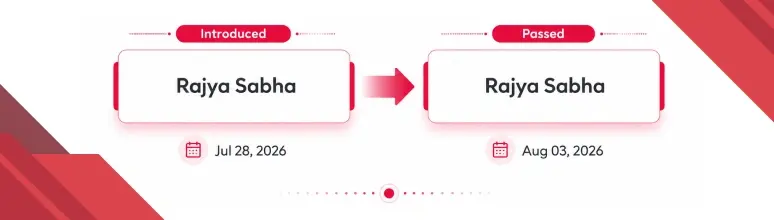
One of the key MSME updates of 2026 is the Micro, Small and Medium Enterprises Development (Amendment) Bill, 2026. The government introduced the Bill in the Rajya Sabha on 28 July 2026, and it was passed on 3 August 2026. Once enacted, the proposed amendments could bring important changes to MSME registration, payment processes, dispute resolution, and legal protections for small businesses.
Here is what it means for all the MSME’s,
1. A New Free Digital Registration Platform
The Bill proposes a new national digital platform where businesses can register as an MSME for free, and it will be completely voluntary. State governments can also set up their own platforms. The idea is to make it easier for more businesses, especially small ones in smaller towns, to come into the formal system and become eligible for government schemes.
2. Faster Payments Through TReDS
One of the biggest headaches for small businesses is getting paid on time by bigger companies. To fix this, the Bill makes it compulsory for every Central Public Sector Enterprise, meaning big government owned companies, to settle their payments to MSMEs through a platform called TReDS.
In simple words, TReDS (Trade Receivables Discounting System) is an electronic platform that facilitates financing of MSME trade receivables through participating financiers.
3. Quicker Resolution of Payment Disputes
If a bigger company delays your payment and you have to raise a dispute, this used to take a long time. The new Bill fixes strict timelines. Mediation between the two sides must be completed within 90 days. If that does not work, arbitration must be completed within another 90 days. The whole process can also happen online now, so you do not need to keep visiting offices in person.
4. Softer Penalties, Not Jail Terms
Earlier, some violations under the MSME law could lead to criminal cases. The new Bill replaces many of these with a system of warnings and graded fines based on the seriousness of the mistake. This makes the law less scary for honest business owners who make small compliance errors.
5. Interim Relief if a Buyer Drags a Case in Court
This one is a big deal for cash flow. Today, if a buyer wants to challenge an award given in favour of an MSME, they first have to deposit 75 percent of the awarded amount in court. But that case can then sit pending for years while the MSME waits for its money.
The new Bill fixes this. If the case stays pending for more than six months, the court must now order at least 50 percent of that deposited amount to be released to the MSME supplier right away. So instead of waiting years for a final decision, a small business can get a big part of its dues much sooner, while the case continues.
6. A Real Penalty for Buyers Who Hide MSME Dues
Buyers are required to report any pending payments to MSMEs in their company’s annual accounts. Earlier, the fine for not doing this was small and did not stop big companies from ignoring it. The new Bill raises the stakes. A buyer who fails to disclose these dues can now be fined starting with a warning for the first time, then a penalty between Rs 10,000 and Rs 50,000 for a second violation, and up to Rs 1 lakh for repeated violations. This penalty amount will also keep increasing by 10 percent every three years, so it does not lose its impact over time.
7. The Government Can Now Update MSME Limits More Easily
Right now, the investment and turnover limits for micro, small and medium enterprises are fixed inside the law itself, which is why changing them needs a bigger process. The new Bill changes this. It allows the central government to decide and update these limits through a simple notification, based on how the economy and inflation are changing. This should make it easier for the classification to stay realistic over time, instead of getting outdated for years before it is revised again.
The Union Budget 2026 – 27 introduced several initiatives to support MSMEs. The government’s focus is on building “Champion MSMEs” that can scale into globally competitive businesses. Here are the key announcements.
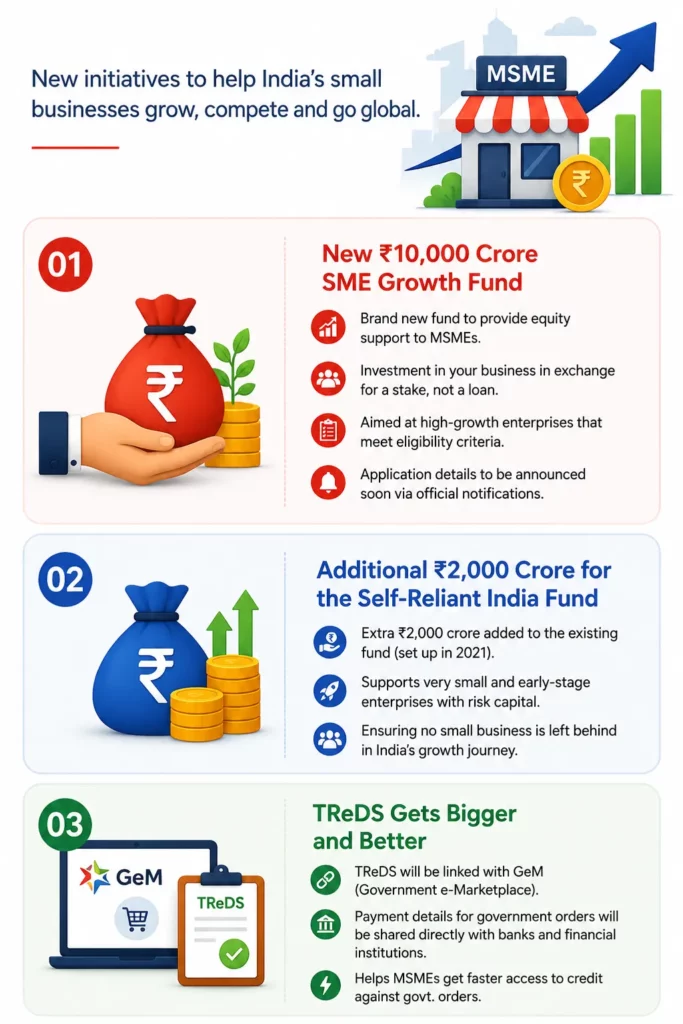
1. A New Rs 10,000 Crore SME Growth Fund
This is a brand new fund meant to give equity support, which means investment in your business in exchange for a stake, rather than a loan you have to repay with interest. It is aimed at enterprises that show strong growth potential and meet certain eligibility criteria. Details on how to apply are expected to be released soon through official notifications.
2. More Money for the Self-Reliant India Fund
An extra Rs 2,000 crore has been added to the existing Self-Reliant India Fund, which was first set up in 2021. This fund is meant to support very small and early stage enterprises with risk capital, so that even the smallest businesses are not left out of this growth push.
3. TReDS Gets Bigger and Better
Along with the mandatory TReDS rule mentioned earlier, the Budget also announced that TReDS will now be linked with GeM, the Government e-Marketplace. This means when the government buys goods or services from MSMEs, the payment information will be shared directly with banks and financial institutions, making it faster for MSMEs to get credit against those government orders.
There is also a plan to let TReDS receivables, meaning the unpaid invoice amounts, be converted into asset backed securities. In simple terms, this means more investors and financial institutions will be able to invest in these unpaid invoices, which should bring more liquidity, meaning more available cash, into the system for small businesses.
How Can Vyapar Help MSMEs Stay Ready for Changing Requirements?
The new MSME measures put greater focus on formal registration, timely payments, digital processes, and better access to finance. For small businesses, this makes it increasingly important to maintain accurate invoices, payment records, and financial information.
Vyapar GST Billing Software helps MSMEs stay organised by bringing billing, payment tracking, inventory, GST records, and business reports into one place. Having these records readily available can make it easier for businesses to manage receivables, maintain financial documentation, and stay prepared when accessing eligible government schemes, credit opportunities, or digital payment mechanisms such as TReDS.
As these changes take effect, technology alone will not ensure compliance or eligibility. But maintaining clear and up-to-date business records can help MSMEs adapt more easily to new requirements and make better use of the opportunities available to them.
Sumit Agarwal is the Founder and CEO of Vyapar, where he leads the company’s mission to simplify business management for MSMEs through accessible technology. With extensive experience in building and scaling technology products, he brings practical insights into entrepreneurship, business management, accounting technology, MSME digitalisation, and SaaS.
Designation: Founder & CEO, Vyapar
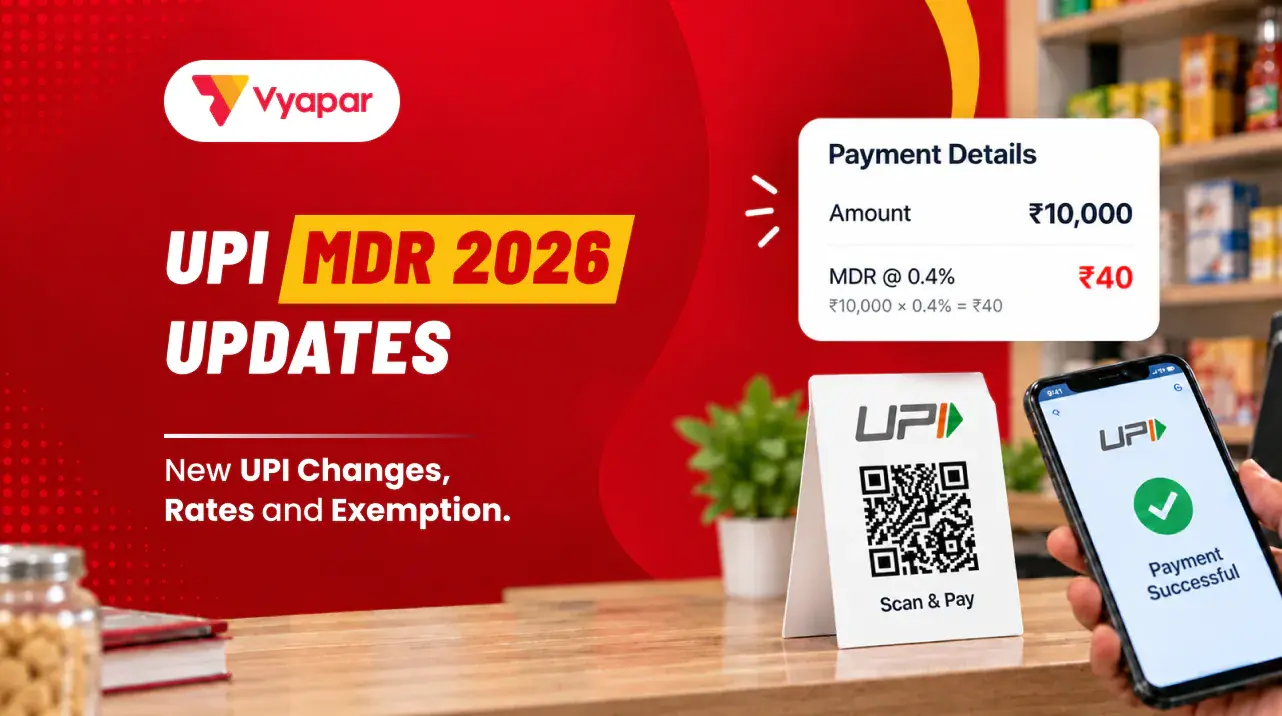
KEY TAKEAWAYS Start date is 15 October 2026: Not 1 April. Messages circulating about an April rollout are wrong The rate is 0.4%: On P2M UPI payments above Rs 2,000, capped at Rs 300 per transaction Small shops pay nothing: Merchants in the P2PM category receiving up to Rs 1 lakh a month have zero…
KEY TAKEAWAYS FSSAI license is mandatory for every food business in India, including restaurants, cloud kitchens, traders, manufacturers, and distributors There are three types: Basic Registration (turnover up to ₹12 lakh), State License (up to ₹20 crore), and Central License (above ₹20 crore) Apply for a food licence online through the official FoSCoS portal at…
Introduction If you have ever taken a business loan or checked EMI rates, you have already been affected by the repo rate. It is the single most important interest rate in India because it decides how expensive or cheap it is for banks to borrow money from the Reserve Bank of India (RBI). That cost…