For most small business owners in India, kirana store owners, retailers, wholesalers, traders, and first-time entrepreneurs, GST compliance often feels confusing. Among all GST concepts, Input Tax Credit (ITC) is the one that can either save you thousands of rupees or land you in trouble if handled incorrectly.
In simple words, input tax credit allows you to reduce the GST you pay on sales by claiming the GST you already paid on purchases. When claimed correctly, it improves cash flow, reduces tax burden, and keeps your business compliant.
However, in 2026, claiming ITC is no longer just about having bills. GST rules have become stricter. Matching invoices, timely returns, vendor compliance, digital records and system-based scrutiny now play a big role.
This guide explains everything about input tax credit in clear, non-technical language. You will learn:
Maintaining digital purchase records makes reconciliation easier.
Step 4: Calculate Input Tax Credits Accurately
While calculating input tax credits, ensure:
Only eligible GST amounts are considered
Blocked credits are excluded
Credit is claimed only once
Example:
Total GST paid on purchases = ₹40,000
Blocked ITC = ₹5,000
Eligible ITC = ₹35,000
Step 5: File GSTR-3B on Time
ITC is officially claimed when you file GSTR-3B.
Late filing can result in:
Interest
Penalties
ITC restrictions
For MSMEs and small shop owners, it acts like a safety net before the sale.
Common ITC Mistakes Small Businesses Make in 2026
Common Mistake
Why It’s a Problem
What You Should Do Instead
Claiming ITC without invoice matching
ITC may not appear in GSTR-2B and can get rejected later
Match purchase invoices with GSTR-2B before claiming ITC
Trusting non-compliant vendors
ITC gets blocked even if GST is paid
Deal with suppliers who regularly file GST returns
Claiming ITC on blocked items
Leads to reversals, penalties, and notices
Check ITC eligibility before claiming credit
Poor record-keeping of invoices
Missing or faded bills cause audit issues
Maintain proper digital records of all purchase invoices
How Technology Helps You Claim ITC Correctly
In 2026, manual methods are risky.
Problems With Traditional ITC Management
Manual calculations
No real-time GST matching
Missed deadlines
Higher chances of errors
Example
A stationery wholesaler in Delhi is supplying notebooks worth ₹1,25,000 to a school. The school needs approval from management before payment.
The wholesaler sends a proforma invoice showing item details, GST, and total amount. After approval and advance payment, the final tax invoice is issued.
Comparison Table: Manual vs Tech-Enabled ITC Management
Aspect
Manual Method
Tech-Enabled System
Invoice Tracking
Paper bills
Digital storage
GSTR-2B Matching
Manual & time-consuming
Automatic
Error Risk
High
Very low
Compliance
Stressful
Simplified
ITC Accuracy
Unreliable
Accurate
Time Spent
Very high
Minimal
Using accounting software like Vyapar helps bring sales, purchases, and eligible ITC into one place, giving a clear picture of your GST position before filing.
How All-in-One Business Software Makes ITC Easy
Modern accounting and billing software is no longer optional; it’s a necessity.
An all-in-one system helps by:
Auto-recording GST invoices
Tracking eligible and blocked ITC
Matching purchases with GSTR-2B
Generating GST-ready reports
Reducing dependency on accountants for daily tasks
For small shop owners, platforms like Vyapar App are designed to keep GST simple without technical jargon. It quietly ensures compliance while you focus on running your shop.
Example: Kirana Store Owner Saving ₹1.2 Lakhs Annually
Ramesh runs a kirana store in Pune.
Earlier:
Manual bills
Missed invoices
Vendor mismatches
Lost nearly ₹10,000 ITC every month
After maintaining digital purchase records and regularly matching GSTR-2B:
Why ITC Compliance Will Get Stricter Going Forward
GST is becoming:
More data-driven
More automated
More system-linked
In 2026 and beyond:
Manual errors will be flagged instantly
Vendor compliance will directly affect your business
Clean data = peace of mind
Conclusion
Input Tax Credit is not a loophole. It is a legal benefit meant to support honest businesses.
When claimed correctly, it:
Improves cash flow
Reduces tax burden
Builds compliance confidence
Keeps your business future-ready
Understanding input tax credit, following the right process, and using the right tools make GST simple, even for non-technical business owners. The key is not complexity. The key is clarity, consistency, and correct records. Small businesses that treat ITC seriously today will be the ones that grow smoothly tomorrow.
Frequently Asked Questions (FAQs)
What is Input Tax Credit (ITC) in simple words?
Input Tax Credit (ITC) means the GST you pay on business purchases can be reduced from the GST you collect on sales. In simple terms, you don’t pay tax twice, once on buying and again on selling.
Can small shop owners and kirana stores claim GST input tax credit?
Yes. Small shop owners, kirana stores, retailers and traders can claim GST input tax credit if they are registered under GST (regular scheme).
Is it mandatory for invoices to appear in GSTR-2B to claim ITC in 2026?
Yes. In 2026, claiming ITC is allowed only if the purchase invoice appears in GSTR-2B. If your supplier has not uploaded the invoice or filed their return, the ITC will not be available until it reflects in GSTR-2B.
What happens if I claim ITC incorrectly?
If ITC is claimed incorrectly:
The excess credit must be reversed
Interest may be charged
Penalties can apply in some cases
You may receive GST notices
Regular reconciliation and correct calculations help avoid these issues.
Can I claim ITC if I paid GST but the supplier did not file returns?
No. Even if you paid GST to the supplier, you cannot claim input tax credit unless the supplier files their GST return and uploads the invoice.
How does accounting or billing software help in claiming ITC correctly?
Billing and accounting software helps by: Recording GST invoices accurately, separating eligible and blocked ITC, and matching purchase data with GSTR-2B. This makes calculating input tax credits easier, faster, and more reliable for small businesses.
Megha Agarwal, CA, is the founder of a Megha & Associates with over 5 years of expertise in accounting, taxation, and business advisory. She specializes in streamlining financial processes and ensuring regulatory compliance to drive sustainable growth for businesses and professionals through practical solutions.
Designation: Chartered Accountant, FCA
Membership Number (MRN): 455035
City: Raipur, C.G
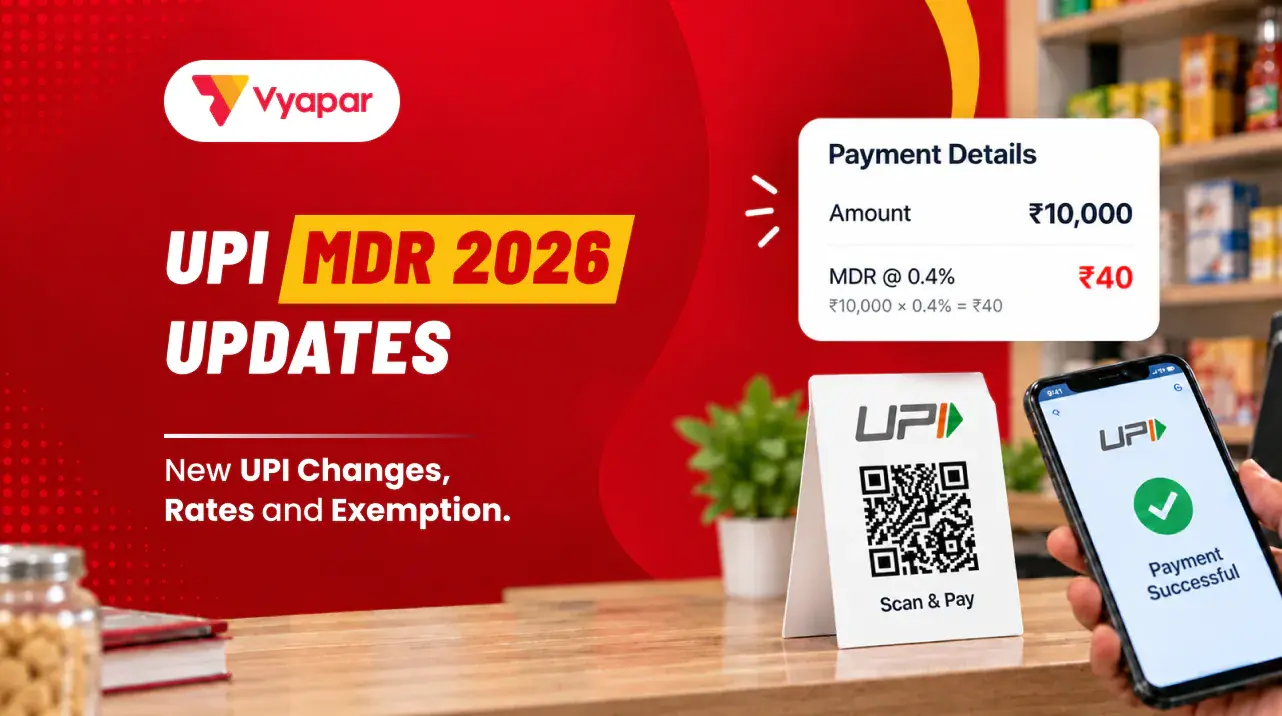
KEY TAKEAWAYS Start date is 15 October 2026: Not 1 April. Messages circulating about an April rollout are wrong The rate is 0.4%: On P2M UPI payments above Rs 2,000, capped at Rs 300 per transaction Small shops pay nothing: Merchants in the P2PM category receiving up to Rs 1 lakh a month have zero…
Introduction On 3 August 2026, the Rajya Sabha passed the Micro, Small and Medium Enterprises Development (Amendment) Bill 2026, bringing some of the biggest changes to MSME rules in years. Along with fresh announcements in the Union Budget 2026-27, there is a lot that MSME owners across India need to know about, from faster payments…
KEY TAKEAWAYS FSSAI license is mandatory for every food business in India, including restaurants, cloud kitchens, traders, manufacturers, and distributors There are three types: Basic Registration (turnover up to ₹12 lakh), State License (up to ₹20 crore), and Central License (above ₹20 crore) Apply for a food licence online through the official FoSCoS portal at…