As the financial year comes to a close, March becomes one of the most important months for GST compliance. Businesses must ensure that their sales data, tax liability, and input tax credit records are properly reconciled before filing returns. Missing deadlines at this stage can create complications during year-end closing and reconciliation for FY 2025-26.
Let’s break down the GST return filing calendar for March 2026 and understand what needs to be filed, when, and how to avoid penalties.
GST Return Filing Calendar for March 2026
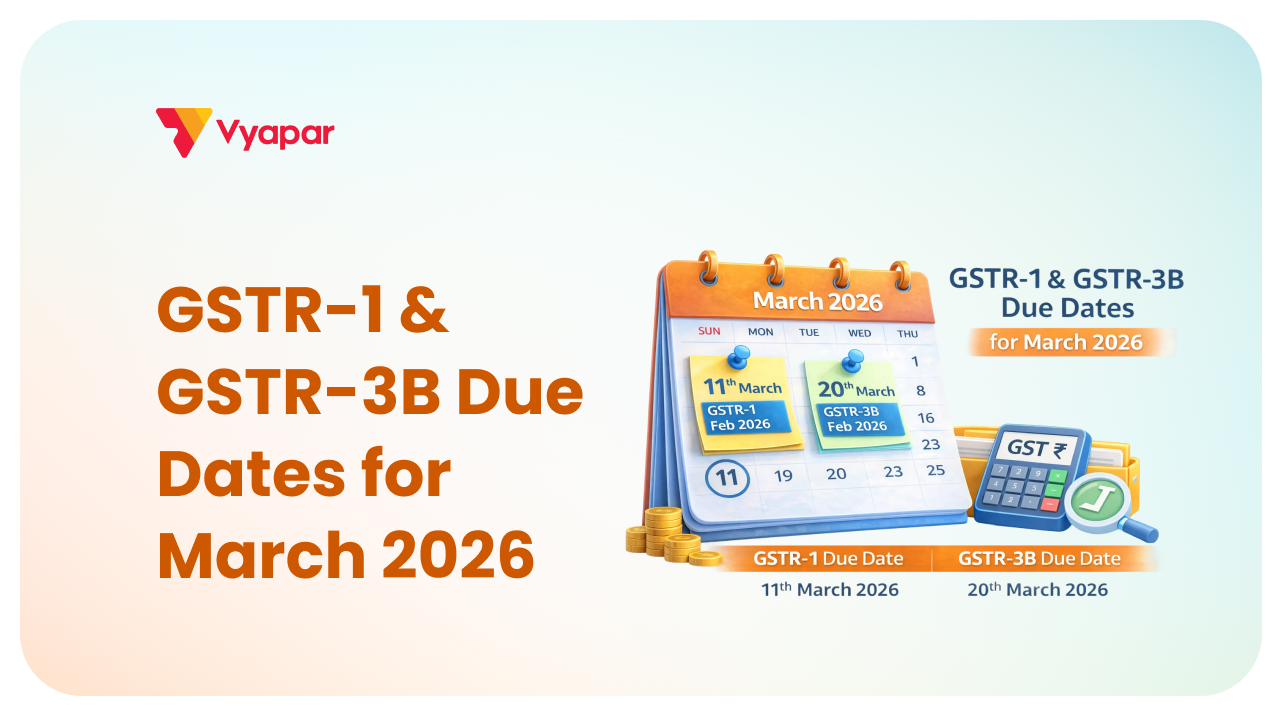
Below is a simple compliance calendar for the key GST returns due in March 2026.
Return Type
Period
Due Date
GSTR-1 (Monthly)
February 2026
March 11, 2026
GSTR-3B (Monthly)
February 2026
March 20, 2026
GSTR-1 (QRMP Scheme)
Jan–Mar 2026
April 13, 2026
GSTR-3B (QRMP Scheme)
Jan–Mar 2026
April 22/24, 2026
These dates are part of the regular GST compliance cycle. However, March filings carry additional importance because they directly affect financial-year reporting and annual return preparation.
Businesses should avoid waiting until the last day, as the GST portal often experiences heavy traffic near deadlines.
GSTR-1 vs. GSTR-3B: What’s the Difference?
Many small business owners confuse GSTR-1 and GSTR-3B, but their purposes are very different.
GSTR-1 is a sales return. It contains invoice-level details of outward supplies made during the month or quarter. This return allows your customers to claim input tax credit based on the invoices you upload.
GSTR-3B, on the other hand, is a summary return with tax payment. It includes total sales, eligible input tax credit, and the final GST liability that must be paid to the government.
In simple terms:
GSTR-1 = Sales details
GSTR-3B = Summary + tax payment
Both returns must match. Any mismatch between GSTR-1 and GSTR-3B can trigger notices or reconciliation issues later.
This is especially important in March, because errors made now often surface during annual return filing.
Late Fees and Penalties for Missing Deadlines
GST late fees can add up quickly if returns are delayed. Even when there is no tax liability, late filing penalties still apply.
Here’s what businesses should keep in mind:
Late fee for GSTR-1: ₹50 per day (₹25 CGST + ₹25 SGST) for returns with sales.
Late fee for GSTR-1: ₹20 per day (₹10 CGST + ₹10 SGST) for Nil returns
As of the date, the GST portal is not levying any late fees for the delay in GSTR-1.
Late fee for GSTR-3B: ₹50 per day (₹25 CGST + ₹25 SGST) for tax-liable returns
Late fee for GSTR-3B: ₹20 per day (₹10 CGST + ₹10 SGST) for Nil returns
Maximum late fee: ₹5,000 per return, (₹2500 CGST + ₹2500 SGST) (in most cases)
Interest on unpaid tax: 18% per annum
Beyond monetary penalties, delayed filing can also result in:
Input tax credit blockage for customers
Compliance rating impact
Difficulty during GST reconciliation
Notices from the department
Even suspension of GST Registration for some cases
That’s why timely filing in March is not just about avoiding penalties, but also about closing the financial year cleanly.
Tips to File Returns Before the Financial Year Ends
March compliance becomes much easier when businesses prepare in advance. A few practical steps can prevent last-minute stress.
Start by reconciling sales data with accounting records. Ensure invoices uploaded in GSTR-1, match your books and GST summary.
Next, verify input tax credit. Cross-check purchase records with GSTR-2B to confirm eligible credits before filing GSTR-3B.
Maintaining updated billing records also makes a big difference. When invoices are recorded daily instead of monthly, return preparation becomes faster and more accurate.
Another helpful step is to review pending invoices. Make sure all March-related transactions are properly recorded before filing returns.
Businesses should also keep sufficient funds ready for GST payment. Waiting until the last day sometimes leads to payment failures or portal delays.
Using accounting or billing software can simplify compliance significantly. Automated GST reports, tax summaries, and return-ready data reduce manual errors and save time.
Most importantly, file returns a few days before the deadline. This buffer helps handle unexpected issues like portal slowdowns, reconciliation mismatches, or bank payment delays.
March is not just another compliance month. It marks the closing of the financial year, and the GST returns filed during this period set the foundation for annual return filing and financial reporting.
Timely filing of GSTR-1 ensures customers receive correct input tax credit information. Filing GSTR-3B on time ensures tax liabilities are settled and books remain compliant.
When businesses treat GST compliance as a routine monthly process rather than a deadline-driven task, year-end filing becomes far smoother.
Staying organized, reconciling regularly, and filing early are the simplest ways to ensure a stress-free GST year-end.
Frequently Asked Questions (FAQs)
Can I file GSTR-3B before filing GSTR-1?
You can not file GSTR- 3B before filing GSTR-1.
What happens if I miss filing GST returns for March?
You may have to pay late fees, interest on tax liability, and face reconciliation issues during annual return filing.
Is GST return filing mandatory even if there were no sales in March?
Yes, businesses must file a NIL return if there are no transactions during the period.
Why is March GST filing important for financial year closing?
March returns help finalize tax liability, input tax credit, and sales records for the entire financial year.
Can GST returns be revised after filing?
GST returns cannot be revised, but corrections and adjustments can be made in subsequent returns.
I'm a Chartered Accountant with 13+ years of experience in finance, taxation, and MSME consulting. I worked with leading industries and with the Vyapar Group, helping businesses simplify their accounting and financial operations.
Designation: Chartered Accountant, FCA
Membership Number (MRN): 418428
City: Raipur, C.G
KEY TAKEAWAYS GST 2.0 introduced a simplified tax structure with major slabs reduced to 0%, 5%, 18%, and 40% from 22 September 2025 The old 12% and 28% GST slabs were largely removed, with items shifted either to 5%, 18%, or 40% Daily essentials like soap, shampoo, butter, ghee, namkeen, notebooks, and insurance became significantly…
KEY TAKEAWAYS Section 44AD offers a presumptive taxation scheme for small businesses to simplify ITR filing Eligible businesses can declare 8% of turnover as income (6% for digital receipts) Turnover limit is ₹2 crore, or ₹3 crore if 95% of receipts are digital No need to maintain books of accounts or get a tax audit…
Introduction As the financial year draws to a close, many business owners feel they’ve missed the window for tax planning. In reality, there’s still time to make a few smart financial decisions before March 31 that can reduce your tax liability for FY 2025-26. For SMEs, proprietors, and professionals, year-end tax planning isn’t about complicated…