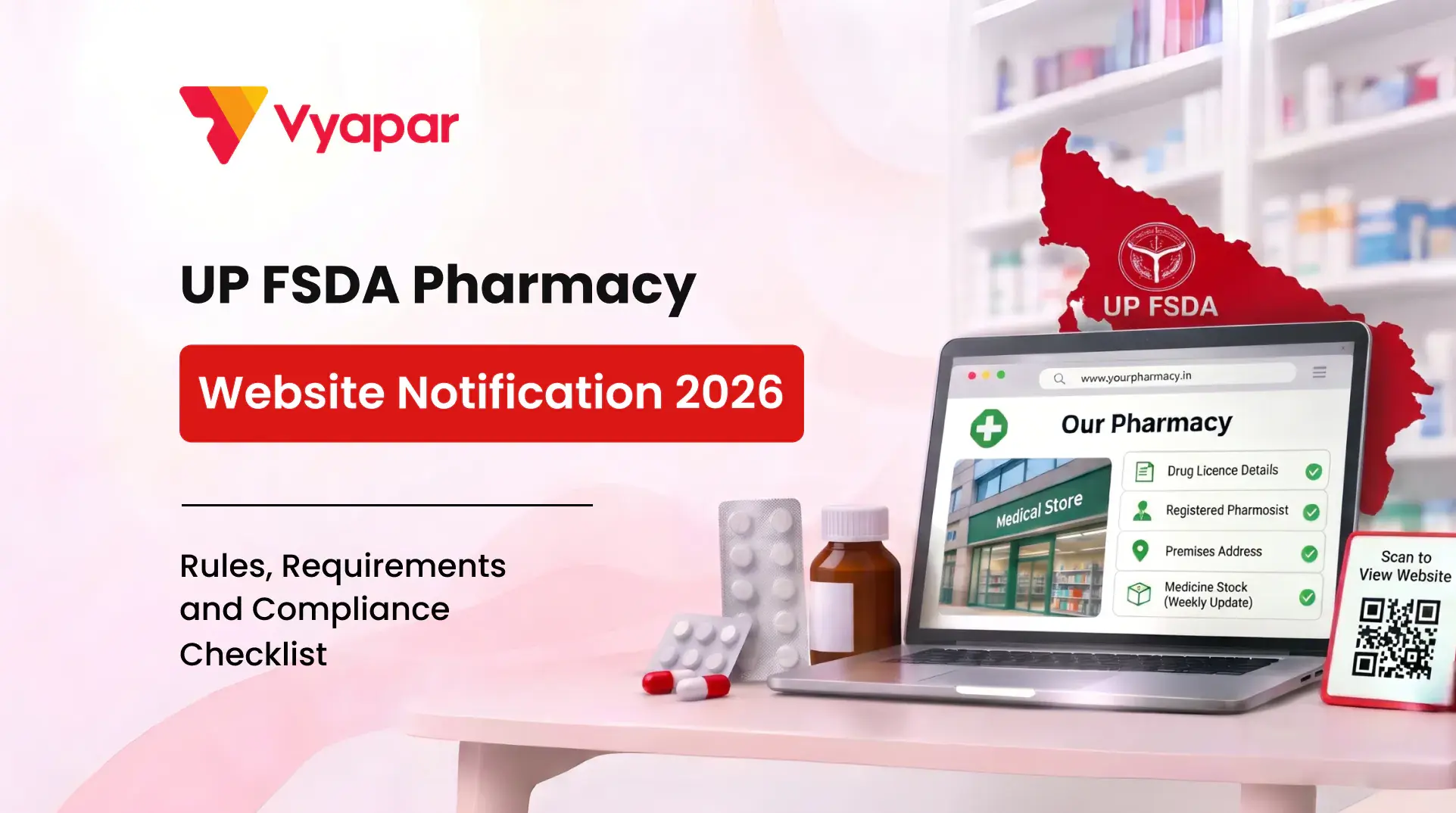
UPFSDA has directed retail pharmacies in Uttar Pradesh, including hospital pharmacies, to maintain a public website with key business details, with implementation announced from 1 November 2026.
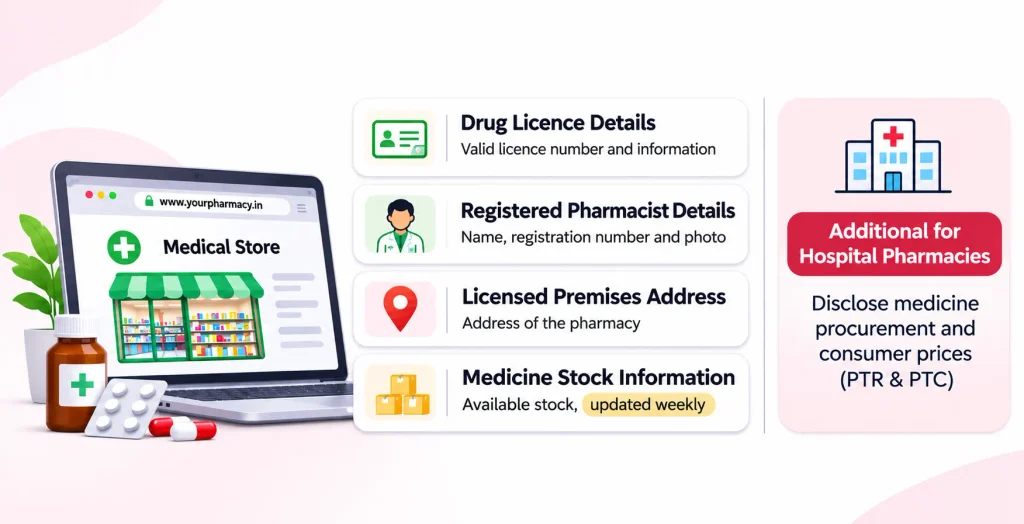
The website must show the drug licence details, the registered pharmacist’s name, registration number and photograph, and the address of the licensed premises.
Medicine stock information must be updated weekly, and the website should be easy to reach through details displayed at the counter, a QR code or an app.
Hospital pharmacies and those serving in-patients must also publish manufacturer, brand and generic names of medicines along with their PTR (Price to Retail) and PTC (Price to Consumer).
The move followed an FSDA review of 214 hospital pharmacies, where 36 of the 130 medicines examined had MRPs more than 10 times their procurement prices.
The notification is aimed at transparency and is not a price-reduction order; existing DPCO 2013 and NPPA pricing rules continue to apply.
A pharmacy owner’s responsibilities go beyond dispensing medicines and maintaining daily sales records. With growing attention on medicine pricing and pharmacy transparency, the Uttar Pradesh Food Safety and Drug Administration (UPFSDA) has introduced new directions requiring retail pharmacies to make essential business information publicly accessible. For pharmacy owners, maintaining organised purchase, billing and stock records through reliable pharmacy billing software can also make this information easier to manage.
The UP FSDA pharmacy website notification is an important development for medical stores, chemists and hospital pharmacies operating across Uttar Pradesh. It requires pharmacies to publish details such as drug licence information, registered pharmacist details, licensed premises and medicine stock on a public website.
Let’s understand what the notification requires, why it was introduced and what pharmacy owners need to consider.
UP FSDA Pharmacy Notification 2026: Key Takeaways
Particular
Details
Regulatory authority
Uttar Pradesh Food Safety and Drug Administration (UPFSDA)
Notification reference reported
FSDA/OC/2026-27/3208
Announced implementation date
1 November 2026
Applicable businesses
Retail pharmacies across Uttar Pradesh, including hospital pharmacies
Website requirement
Publicly accessible pharmacy website
Stock update frequency
Weekly
Additional pricing disclosure
PTR and PTC details for hospital pharmacies and those serving in-patients
Primary objective
Improve pharmacy and medicine pricing transparency
Note: These details are based on published reporting of the FSDA directions. Pharmacy owners should verify the original circular and any subsequent clarifications with the relevant drug licensing authority.
What Is the UP FSDA Pharmacy Website Notification?
The UP FSDA pharmacy website notification is a regulatory initiative aimed at making essential information about pharmacies accessible to the general public.
Previously, customers generally depended on information displayed at the pharmacy counter or details shared by the pharmacist. Under the reported directions, retail pharmacies must maintain a public website that displays important operational and licensing information.
This includes the pharmacy’s drug licence number, details of the appointed pharmacist, address of the licensed premises and medicine stock information.
The information must be updated regularly, with stock details requiring weekly updates. Pharmacies must also make their website accessible to customers through prominently displayed website details, QR codes or an app.
The initiative also introduces additional pricing transparency requirements for hospital pharmacies, particularly those serving admitted patients.
The reported directions were issued by UPFSDA Commissioner Roshan Jacob under circular reference FSDA/OC/2026-27/3208.
Why Has UPFSDA Introduced This Notification?
One of the major reasons behind this initiative is the difference observed between medicine procurement prices and their printed Maximum Retail Prices (MRPs).
According to an investigation reported by The Indian Express, UPFSDA examined pricing information collected from 214 pharmacies attached to medical colleges and private hospitals.
The findings highlighted significant differences between procurement costs and printed MRPs.
Some key findings included:
214 hospital pharmacies were covered in the inspection.
130 medicines were examined for price differences.
36 medicines had MRPs more than 10 times their procurement prices.
In one reported case, a Polymyxin-B injection purchased for ₹74.09 carried an MRP of ₹4,980.94.
This difference of nearly 67 times brought greater attention to medicine pricing transparency.
The department wanted to improve visibility into the medicine supply chain and help patients understand the relationship between medicine procurement and selling prices, particularly in hospital pharmacies where patients may have limited purchasing alternatives.
The website initiative is intended to make essential information accessible rather than keeping it available only during regulatory inspections.
What Information Must Pharmacies Display on Their Websites?
The reported UPFSDA directions outline specific information that retail pharmacies must make publicly accessible.
1. Drug Licence Information
Every retail pharmacy must publish its valid drug licence details on its website.
This includes the relevant licence number and licence-holder information.
Pharmacy owners should ensure that the online details match their actual licensing records.
2. Registered Pharmacist Details
Pharmacies must display details of the appointed pharmacist, including:
Pharmacist’s full name.
Registration number.
Photograph.
These details help customers identify the registered professional associated with the pharmacy.
3. Licensed Premises Address
The website must display the address of the licensed pharmacy premises.
This makes it easier for customers to identify the pharmacy and verify its operating location.
4. Medicine Stock Information
Retail pharmacies must publish information about their available medicine stock.
The stock information must be updated weekly so that the published details remain relevant.
Maintaining accurate inventory records becomes especially important here. Pharmacy owners should regularly reconcile their purchases, sales, returns and available quantities before updating the website.
5. Public Website Accessibility
The website must be accessible to the general public.
The website address must be prominently displayed at the pharmacy counter. Customers should also be able to access the information through a QR code or an app, as described in published reports.
This makes the information accessible without requiring customers to request physical documents from the pharmacy.
Additional Requirements for Hospital Pharmacies: PTR and PTC Disclosure
Apart from the general website requirements, UPFSDA has introduced additional medicine price-disclosure directions for hospital pharmacies and pharmacies serving in-patients.
These pharmacies must publish the manufacturer, brand and generic names of medicines, along with their procurement and consumer prices.
To understand this requirement, pharmacy owners should know three important pricing terms.
Term
Full Form
Meaning
PTR
Price to Retail
Price at which the pharmacy purchases a medicine from its supplier or manufacturer.
PTC
Price to Consumer
Price at which the medicine is sold to the patient.
MRP
Maximum Retail Price
Maximum retail price printed on the medicine packaging.
Why Are PTR and PTC Important?
PTR and PTC help show the difference between what a pharmacy pays to procure a medicine and what the patient pays when purchasing it.
For example:
Suppose a hospital pharmacy purchases a medicine for ₹200 and sells it to a patient for ₹250.
PTR: ₹200
PTC: ₹250
Difference: ₹50
Making these figures publicly accessible allows patients to understand the medicine’s procurement and selling prices.
However, the difference between PTR and PTC should not automatically be interpreted as the pharmacy’s net profit. Business expenses, applicable taxes and other operational costs must also be considered.
The objective of the disclosure is to improve transparency, particularly in hospital settings.
Does the UP FSDA Notification Mean Medicine Prices Will Come Down?
Not necessarily.
The notification focuses on making pharmacy information and medicine pricing more transparent. It is not, by itself, a blanket price-reduction order.
Publishing PTR and PTC does not mean that every pharmacy must sell medicines at their procurement price.
The existing provisions relating to medicine pricing, applicable MRP limits and NPPA regulations continue to apply.
The Drugs (Prices Control) Order, 2013, also contains provisions concerning the display of medicine price lists and the prices at which formulations can be sold.
The key difference is that the UPFSDA initiative aims to make relevant pricing information more accessible to patients.
Pharmacy Compliance Checklist: What Should Medical Store Owners Prepare?
Maintaining accurate records is an important part of preparing for greater digital transparency.
Pharmacy owners can start by reviewing the following areas.
Checklist
What to verify
Drug licence
Keep the current licence details readily available.
Pharmacist information
Verify the pharmacist’s name, registration number and photograph.
Premises details
Ensure the address matches the licensed premises.
Medicine inventory
Maintain accurate medicine names and stock quantities.
Batch details
Record batch numbers and expiry dates for medicines.
Purchase records
Maintain supplier invoices and procurement information.
Pricing records
Keep PTR, PTC and MRP information accurate wherever applicable.
Website
Verify that the website is publicly accessible.
QR code
Check that scanning the QR code opens the correct website.
Weekly updates
Establish a fixed schedule for checking and updating stock information.
An additional operational suggestion: Maintain a record of each weekly stock update and its date. This can make it easier to identify discrepancies and maintain consistency between physical inventory and published information.
How Can Pharmacy Billing and Inventory Software Help?
For example, Vyapar provides features that support:
Batch-wise inventory management: Maintain medicine stock with relevant batch details.
Expiry date tracking: Record and monitor medicine expiry dates.
Purchase and sales records: Maintain transaction records for better visibility into stock movements.
Barcode billing: Reduce manual item-entry work at the billing counter.
Drug licence details: Add the drug licence number to invoices.
Schedule H and H1 records: Maintain relevant digital transaction records for these medicine categories.
These capabilities can help pharmacies maintain more organised business records.
It is important to remember that billing and inventory software does not automatically replace the public website requirement. Pharmacy owners must separately verify the website specifications and complete the required disclosures.
Prepare Your Pharmacy for UP FSDA Compliance
The UP FSDA pharmacy website notification marks an important step towards improving transparency in pharmacy operations and medicine pricing.
By making licence information, pharmacist details and medicine stock publicly accessible, the initiative aims to give customers better visibility into pharmacy operations. The additional price-disclosure requirements for hospital pharmacies also bring greater attention to medicine procurement and consumer pricing.
For pharmacy owners, maintaining accurate digital records, organised inventory and updated business information will become increasingly important.
Adopting better billing and inventory management practices can help medical stores organise their daily operations while preparing for evolving regulatory requirements.
Megha Agarwal, CA, is the founder of a Megha & Associates with over 5 years of expertise in accounting, taxation, and business advisory. She specializes in streamlining financial processes and ensuring regulatory compliance to drive sustainable growth for businesses and professionals through practical solutions.
Designation: Chartered Accountant, FCA
Membership Number (MRN): 455035
City: Raipur, C.G
KEY TAKEAWAYS Start date is 15 October 2026: Not 1 April. Messages circulating about an April rollout are wrong The rate is 0.4%: On P2M UPI payments above Rs 2,000, capped at Rs 300 per transaction Small shops pay nothing: Merchants in the P2PM category receiving up to Rs 1 lakh a month have zero…
Introduction On 3 August 2026, the Rajya Sabha passed the Micro, Small and Medium Enterprises Development (Amendment) Bill 2026, bringing some of the biggest changes to MSME rules in years. Along with fresh announcements in the Union Budget 2026-27, there is a lot that MSME owners across India need to know about, from faster payments…
KEY TAKEAWAYS FSSAI license is mandatory for every food business in India, including restaurants, cloud kitchens, traders, manufacturers, and distributors There are three types: Basic Registration (turnover up to ₹12 lakh), State License (up to ₹20 crore), and Central License (above ₹20 crore) Apply for a food licence online through the official FoSCoS portal at…