Anshika Jain is a Product Manager at Vyapar, building products that empower millions of MSMEs to digitize, market, and grow their businesses. With experience in product strategy, user research, and customer-centric product development, she focuses on solving real business challenges through simple and scalable technology.
Vyapar Editorial Team represents the officially authorized content and review function at Vyapar App, a business management, billing and accounting software used by millions of SMEs. Articles published under this author are created and reviewed by subject-matter experts to ensure accuracy, compliance, and practical business value.
Inventory meaning: Inventory refers to the goods, raw materials and supplies a business holds for sale, production or operational use.
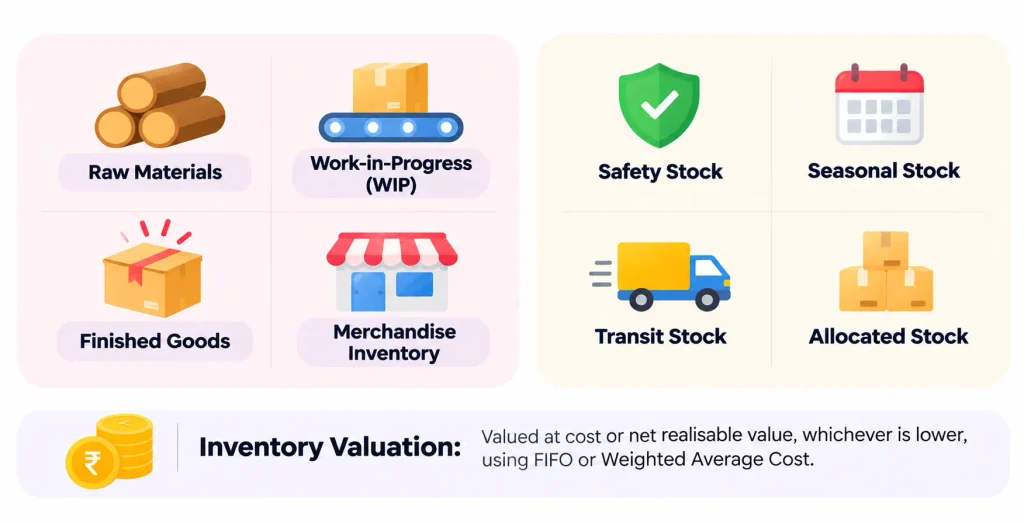
Types of inventory: Common categories include raw materials, work-in-progress (WIP), finished goods, merchandise inventory and MRO supplies.
Inventory by purpose: Businesses maintain safety stock, seasonal inventory, anticipation inventory, transit inventory and allocated stock to meet different requirements.
Why inventory matters: Proper inventory management helps prevent stock shortages, reduce wastage, control costs and maintain healthy cash flow.
Inventory valuation: Inventory is generally valued at cost or net realisable value, whichever is lower, using FIFO or weighted average cost methods.
Inventory examples: Groceries in a kirana store, medicines in a pharmacy, fabric in a garment factory and flour in a bakery are common examples.
Inventory tracking: Businesses can use inventory management software like Vyapar to track stock movements, monitor quantities, manage godowns and maintain batch and expiry records.
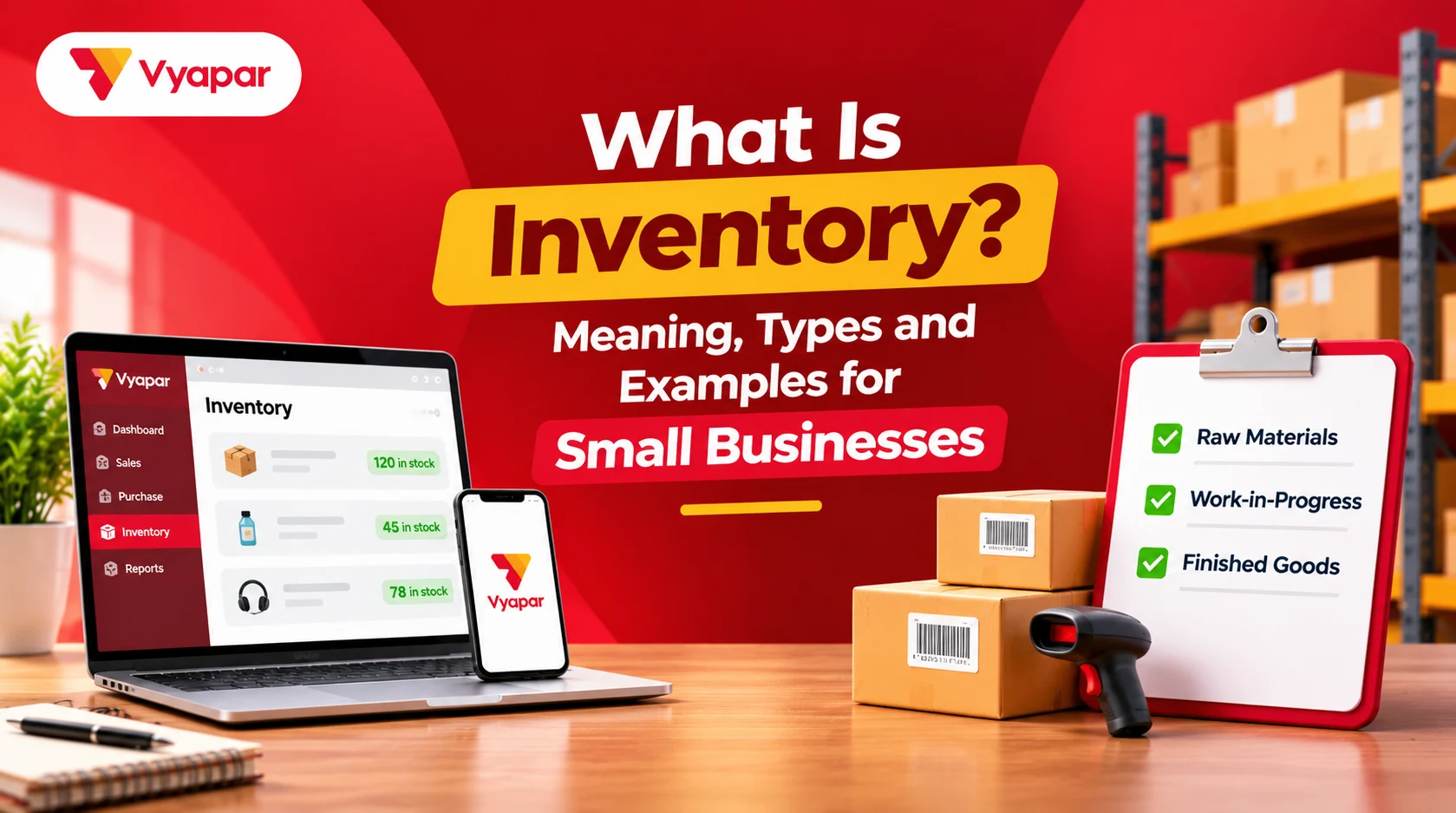
What Is Inventory? Meaning, Types and Examples for Small Businesses
For a small business, inventory represents money invested in products, raw materials and supplies. Managing it properly helps business owners avoid stock shortages, reduce wastage and maintain healthy cash flow.
But what exactly is inventory? What are its different types, and how do businesses calculate and track it?
What Is Inventory?
Inventory refers to the goods, materials and supplies a business holds for sale, uses in production, or consumes while providing services. It is also commonly called stock.
In simple terms, inventory is everything a business keeps available to sell or use to produce something it sells.
For example:
A kirana store’s inventory includes rice, pulses, packaged food and toiletries.
A garment manufacturer’s inventory includes fabric, buttons, unfinished garments and ready-to-sell clothes.
A pharmacy’s inventory includes medicines, healthcare products and medical supplies.
A bakery’s inventory includes flour, sugar, butter and finished baked products.
In accounting, inventory is generally classified as a current asset because it is expected to be sold, consumed or converted into revenue during the normal operating cycle.
Why Is Inventory Important for a Business?
Inventory directly affects a business’s sales, expenses and working capital. Maintaining the right quantity ensures that products are available when customers need them without tying up too much money in unsold stock.
Here are five reasons why inventory matters:
1. Prevents stock shortages
Businesses need sufficient stock to fulfil customer orders. Running out of popular products can lead to missed sales and customers switching to competitors. To avoid this, businesses can set minimum stock levels and use low-stock alerts to get notified when product quantities fall below the required threshold.
For example, if a grocery store regularly sells a popular cooking oil brand, a stock alert can notify the owner when its quantity drops below the set limit, allowing them to reorder before running out.
2. Improves cash flow
Inventory requires investment. Excess stock ties up money that could otherwise be used for rent, salaries, supplier payments and business expansion.
Maintaining appropriate stock levels helps businesses use their working capital more efficiently.
3. Reduces wastage and product expiry
Businesses dealing with perishable goods, medicines and seasonal products must monitor inventory carefully.
Tracking purchase dates, batches and expiry dates helps reduce losses caused by expired, damaged or obsolete products.
4. Supports better purchasing decisions
Knowing which products sell quickly and which remain unsold helps business owners plan future purchases.
For instance, a garment retailer can use previous sales data to decide how many winter jackets to purchase before the next season.
5. Improves business planning
Accurate inventory records help businesses understand their stock position, estimate purchasing requirements and plan production schedules.
This makes it easier to manage suppliers, fulfil orders and avoid unnecessary purchases.
What Are the Different Types of Inventory?
Inventory can be classified in different ways depending on the business, the stage of production and the reason for holding stock.
The most common classification is based on the stage of production. Businesses also classify inventory according to its purpose, movement and ownership.
Types of Inventory Based on Production Stage
Type
Meaning
Example
Raw materials
Basic materials used to manufacture products
Cotton, wood, flour
Work-in-progress (WIP)
Products that have entered production but are not finished
Cut fabric waiting to be stitched
Finished goods
Completed products ready for sale
Packaged biscuits, stitched shirts
Merchandise inventory
Finished products purchased for resale
Mobile phones in an electronics shop
MRO inventory
Maintenance, repair and operating supplies
Tools, lubricants and cleaning materials
Packing materials
Materials used to package products
Boxes, labels and packaging tape
Let’s understand these inventory types with examples.
1. Raw Materials Inventory
Raw materials are the basic inputs a business uses to manufacture products. They are purchased from suppliers and converted into finished goods through production.
Examples include:
Cotton used in garment manufacturing.
Wood used in furniture production.
Flour and sugar used in bakeries.
Steel used in automobile manufacturing.
Manufacturers generally calculate raw material requirements based on their production plans.
For example, if a furniture manufacturer plans to produce 100 chairs, the quantity of wood, screws and polish required will depend on the number of chairs being manufactured.
This is known as dependent demand because the requirement for raw materials depends on the demand for the finished product.
2. Work-in-Progress (WIP) Inventory
Work-in-progress inventory refers to products that have started the manufacturing process but are not yet complete.
It includes the cost of raw materials already used, direct labour and applicable production overheads.
For example, in a garment factory:
Fabric that has been cut but not stitched is WIP.
Shirts that have been stitched but are awaiting finishing are WIP.
Monitoring WIP helps manufacturers identify production delays, bottlenecks and unnecessary work-in-progress accumulation.
3. Finished Goods Inventory
Finished goods are products that have completed the manufacturing process and are ready to be sold to customers.
Examples include:
Packaged biscuits in a food manufacturing unit.
Stitched shirts in a garment factory.
Manufactured furniture ready for delivery.
Businesses need to track finished goods to understand how much stock is available for sale and fulfil customer orders on time.
Example: A manufacturer produces 100 shirts at a total production cost of ₹20,000.
Cost per shirt = ₹20,000 ÷ 100 = ₹200. If each shirt is sold for ₹300, the gross profit per shirt is ₹100 before other business expenses.
4. Merchandise Inventory
Merchandise inventory consists of finished products that retailers and wholesalers purchase from suppliers to resell without further manufacturing.
Examples include:
Mobile phones in an electronics store.
Medicines in a pharmacy.
Packaged groceries in a supermarket.
Hardware products in a hardware shop.
Unlike manufacturers, retailers primarily manage merchandise inventory rather than raw materials and work-in-progress.
5. MRO Inventory
MRO stands for Maintenance, Repair and Operations.
MRO inventory includes supplies required to maintain equipment and keep daily business operations running. These items are generally consumed during operations rather than sold directly to customers.
Examples include:
Machine lubricants.
Cleaning supplies.
Protective equipment.
Small maintenance tools.
Consumable spare parts.
For manufacturers, tracking MRO supplies helps prevent operational disruptions caused by unavailable maintenance materials.
Note that major machinery and spare parts that qualify as fixed assets are accounted for separately rather than automatically treated as inventory.
6. Packing Materials Inventory
Packing materials are items used to package, protect, store and transport products.
Examples include:
Cardboard boxes.
Plastic packaging.
Labels and stickers.
Bubble wrap.
Carry bags and sealing tape.
Businesses that ship products regularly need to maintain sufficient packing materials to avoid delays in order fulfilment.
Types of Inventory Based on Purpose
Apart from production stages, businesses also classify inventory according to why they hold it.
Type
Meaning
Example
Safety stock
Extra stock maintained to handle unexpected demand or supply delays
Additional packets of a fast-selling product
Seasonal inventory
Stock purchased before a predictable seasonal demand increase
Umbrellas before monsoon
Anticipation inventory
Stock purchased ahead of an expected event or price increase
Additional products before a planned promotional sale
Transit inventory
Goods currently being transported between locations
Products travelling from Surat to Pune
Allocated inventory
Stock reserved for confirmed customer orders
Sarees reserved for a wedding order
Unplanned inventory
Excess stock resulting from unexpected circumstances
Unsold winter jackets
7. Safety Stock Inventory
Safety stock is additional inventory maintained to protect businesses against unexpected demand increases, supplier delays or supply disruptions.
For example, a grocery store may keep an additional 20 packets of a fast-selling atta brand to avoid running out if its regular supplier delivers late.
The purpose of safety stock is to maintain product availability when normal inventory levels are insufficient.
8. Seasonal Inventory
Seasonal inventory refers to products purchased or stored in advance of predictable periods of increased demand.
Examples include:
Umbrellas and raincoats before monsoon.
Sweets and decorative items before Diwali.
Woollen clothes before winter.
School supplies before the academic session begins.
Businesses usually plan seasonal inventory using previous sales trends, seasonal demand and expected customer requirements.
9. Anticipation Inventory
Anticipation inventory is stock purchased in advance to prepare for an expected increase in demand, a promotional event or an anticipated price increase.
For example, an electronics retailer may increase mobile phone inventory before a major festive sale.
The difference between seasonal and anticipation inventory is that seasonal inventory is linked to recurring seasonal demand, whereas anticipation inventory can be built for any expected future event.
10. Transit Inventory
Transit inventory refers to goods that are currently being transported from one location to another.
For example, products dispatched by a supplier in Surat and travelling to a retailer in Pune are considered goods in transit.
Businesses should track transit inventory to monitor deliveries, avoid duplicate orders and maintain accurate stock records.
Ownership of goods in transit depends on the agreed terms of sale and the point at which ownership transfers.
11. Allocated Inventory
Allocated inventory refers to stock reserved for a specific customer order or business requirement.
Although the products may still be physically available in the warehouse, they cannot be treated as freely available stock.
Example:
A retailer has 50 cartons of detergent in its warehouse. A customer has already placed an order for 12 cartons.
Available inventory = Stock on hand − Allocated stock Available inventory = 50 − 12 = 38 cartons. The retailer has 38 cartons available for other customers.
12. Unplanned Inventory
Unplanned inventory refers to excess stock that accumulates because of unexpected changes in demand, incorrect purchasing decisions or supplier-related issues.
For example, a clothing retailer may have a large quantity of winter jackets remaining after an unusually warm winter.
Unplanned inventory can increase storage costs, tie up working capital and create the risk of products becoming obsolete.
Regular stock reviews, demand forecasting and purchase planning help businesses control excess inventory.
Some businesses also manage inventory based on the nature of their products or ownership arrangements.
Three examples include FMCG inventory, consignment inventory and rental inventory.
13. FMCG Inventory
FMCG stands for Fast-Moving Consumer Goods. These are everyday products that consumers purchase frequently and that generally have a relatively high sales turnover.
Examples include:
Milk and dairy products.
Bread and packaged food.
Soap and toothpaste.
Personal care products.
Packaged snacks and beverages.
FMCG inventory requires regular monitoring because some products have limited shelf lives and are vulnerable to expiry.
Businesses should follow the First In, First Out (FIFO) approach where appropriate and maintain batch and expiry-date records.
14. Consignment Inventory
Consignment inventory refers to products supplied by one business (the consignor) to another business (the consignee) for sale.
The consignee sells the products and pays the consignor according to the agreed arrangement. In a typical consignment arrangement, the consignor retains ownership of unsold goods.
Example:
A handicraft manufacturer supplies 50 products to a retail shop on a commission basis.
If the shop sells a product for ₹100 and receives a 20% commission:
Selling price: ₹100
Retailer’s commission: ₹20
Amount payable to manufacturer: ₹80
Unsold products remain subject to the agreed consignment arrangement.
GST consideration: The GST treatment of principal-agent transactions depends on the nature of the arrangement and the invoicing relationship. Under Schedule I of the CGST Act, certain supplies between a principal and an agent can be treated as supplies even without consideration. CBIC Circular No. 57/31/2018-GST explains the relevant invoicing distinction. Businesses should confirm the treatment of their specific arrangement with a qualified tax professional.
15. Rental Inventory
Rental inventory includes products and equipment that a business owns and rents out to customers for repeated use.
Examples include:
Chairs and tables in a tent house business.
Cameras and photography equipment.
Construction equipment.
Cars and commercial vehicles.
Party supplies and event equipment.
Unlike regular merchandise inventory, rental inventory is not sold every time it is used.
Businesses need to track:
Availability of each item.
Customer or location to which it has been issued.
Expected return date.
Product condition and maintenance requirements.
This helps prevent double bookings, missing equipment and unnecessary replacement costs.
How Is Inventory Valued in Accounting?
Inventory valuation refers to the process of calculating the monetary value of goods and materials held by a business at a particular time.
It helps businesses determine the value of closing stock, calculate the cost of goods sold and prepare accurate financial statements.
Under Accounting Standard 2 (AS 2) and Indian Accounting Standard 2 (Ind AS 2), applicable inventory is generally valued at cost or net realisable value, whichever is lower.
Other costs incurred to bring inventory to its present location and condition.
What Is Net Realisable Value?
Net realisable value (NRV) is the estimated selling price of inventory in the ordinary course of business, less the estimated costs of completion and the costs necessary to make the sale.
For example:
If a product has a recorded cost of ₹500 but can now be sold for only ₹450, with no additional selling costs, its net realisable value is ₹450.
The inventory should therefore be valued at ₹450.
What Are the Methods of Inventory Valuation?
Two commonly permitted cost formulas for ordinarily interchangeable inventory under Indian accounting standards are:
1. FIFO (First In, First Out)
FIFO assumes that the inventory purchased or produced first is sold first.
For example, a retailer purchases:
10 units at ₹100 each.
10 additional units at ₹120 each.
If the retailer sells 10 units, FIFO assigns the cost of the first batch (₹100 per unit) to those units.
2. Weighted Average Cost Method
This method calculates the average cost of inventory by considering the cost and quantity of available units.
Weighted average cost = ₹2,200 ÷ 20 = ₹110 per unit.
LIFO (Last In, First Out) is not an accepted cost formula under AS 2 and Ind AS 2 for inventory valuation.
The appropriate accounting treatment depends on the applicable accounting framework and the nature of the inventory.
For a detailed explanation, read our guide on [inventory valuation methods].
What Are Some Examples of Inventory in Different Businesses?
Inventory varies depending on the products a business sells, manufactures or uses during its operations.
Here are some common examples across Indian businesses.
Business
Inventory examples
Inventory category
Kirana store
Rice, pulses, packaged food, toiletries
Merchandise and FMCG
Pharmacy
Medicines, medical supplies
Merchandise inventory
Bakery
Flour, sugar, butter, baked products
Raw materials and finished goods
Garment manufacturer
Fabric, cut pieces, stitched clothes
Raw materials, WIP and finished goods
Hardware shop
Tools, fittings, paint and construction supplies
Merchandise inventory
Furniture manufacturer
Wood, screws, unfinished furniture
Raw materials, WIP and finished goods
Electronics retailer
Mobile phones, laptops and accessories
Merchandise inventory
Tent house
Chairs, tents, lighting equipment
Rental inventory
How Can Businesses Manage and Track Inventory Effectively?
Managing inventory involves more than knowing how many products are available. Businesses need to monitor purchases, sales, stock movements and reorder requirements to maintain accurate inventory records.
Here are some practical ways to manage inventory efficiently:
1. Maintain accurate stock records
Record every purchase, sale, return and stock adjustment. This helps ensure that recorded inventory matches the actual quantity available.
2. Set reorder levels
Determine the minimum stock quantity at which a product should be reordered.
For example, if a grocery store sells approximately 10 packets of a product daily and its supplier takes three days to deliver, the business should plan its replenishment accordingly.
3. Monitor fast-moving and slow-moving products
Identify products that sell frequently and those that remain unsold for longer periods.
This helps businesses plan purchases, avoid excess stock and identify products that may require promotional offers.
4. Conduct regular stock audits
Compare physical stock with recorded inventory to identify discrepancies caused by damage, theft, incorrect entries or unrecorded transactions.
5. Track batches and expiry dates
Businesses dealing with food, medicines and other perishable products should maintain batch-wise inventory records and monitor expiry dates.
6. Use inventory management software
Manual stock registers and spreadsheets become difficult to maintain as product quantities, purchases and sales increase.
Inventory management software helps businesses record stock movements, monitor available quantities and generate inventory reports from a central system.
For more information, read our guide on [inventory control and management].
How Does Vyapar Help Small Businesses Track Inventory?
Managing stock manually can become challenging when a business handles multiple products, suppliers, purchases and sales every day.
Vyapar inventory management software helps small businesses maintain stock records by updating inventory when purchases and sales are recorded.
Here are some useful inventory management capabilities:
1. Real-time stock updates
Stock quantities are updated when businesses record purchases and create sales bills, helping maintain more accurate inventory records.
2. Stock summary reports
Business owners can check available quantities for individual products through stock reports and monitor their inventory position.
3. Batch and expiry tracking
Businesses dealing with medicines, food and other expiry-sensitive products can maintain batch and expiry information. Batch tracking is available as part of the applicable premium plan.
4. Multiple godown management
Businesses managing stock across different storage locations can maintain godown-wise inventory records and manage stock movements between locations.
To get started, enable Stock Maintenance under Settings, enter the opening stock for your products and record purchases and sales to maintain updated stock records.
Anshika Jain is a Product Manager at Vyapar, building products that empower millions of MSMEs to digitize, market, and grow their businesses. With experience in product strategy, user research, and customer-centric product development, she focuses on solving real business challenges through simple and scalable technology.
Introduction For any small business in India dealing with stock, dead inventory and stockouts are the two fastest ways to lose money. The right inventory management software for small business tracks every SKU in real time, alerts you before stock runs out, handles GST and e-way bills, and shows which items are actually making you…
KEY TAKEAWAYS Dead stock is inventory that has remained unsold for an extended period and is unlikely to sell It ties up working capital, wastes storage space, and quietly erodes profit margins Common causes include overordering, poor demand forecasting, and seasonal misjudgment You can clear dead stock through discounts, bundling, liquidation, and stock transfers Prevention…
Introduction As we have seen, the general store is a very needful and economical household business shop. Containing items like Kirana items, clothes, small electrical items, and medicines, etc. Here you will find the vast no of category items. Knowing the inventory of the items, judging the customer demand, maintaining party outstanding, tracking history, and…