I’m a business enthusiast with 8+ years of experience in business management and finance, holding a Bachelor of Business Management (BBM) in Marketing and an MBA in Finance. With expertise in marketing, accounting, financial management, business law, MIS, and business economics, I focus on simplifying complex business and finance topics into clear, practical insights for entrepreneurs, professionals, and students.
Vyapar Editorial Team represents the officially authorized content and review function at Vyapar App, a business management, billing and accounting software used by millions of SMEs. Articles published under this author are created and reviewed by subject-matter experts to ensure accuracy, compliance, and practical business value.
Accounting is how a business keeps track of its money. You write down every rupee that comes in and goes out, sort those entries and turn them into reports that show your profit.
Quick Summary
Accounting meaning: Accounting means recording, sorting and explaining your business’s money transactions.
Types of accounting: There are four main types: financial, cost, management and tax accounting.
Accounting cycle: The accounting cycle has 8 steps, from collecting bills to closing the books.
Financial year: Most Indian businesses keep their books from 1 April to 31 March, now called the “tax year” under the Income-tax Act, 2025.
Trial balance: A trial balance that tallies doesn’t prove your books are right.
What is Accounting?
Accounting means recording and organising a business’s financial transactions. It helps owners understand their business’s financial position, calculate profit, track what they own and owe, and manage taxes.
It does five jobs:
Recording every sale, purchase, payment and expense;
Sorting similar entries into accounts;
Summarising them into reports;
Analysing what the numbers say;
Reporting the results to the owner, the bank and the tax department.
For example, you sell a phone cover for ₹300 on Monday. Accounting records the sale, adds it to Monday’s total and, at month-end, counts it in your sales and profit.
Objectives of Accounting
Keep a record of every transaction
Find the profit or loss for a period
Show what the business owns and owes
Give figures to the owner, banks and the tax department
Meet GST, income tax and company law needs
Key Types of Accounting
Type
What it does
Example
Financial accounting
Prepares the profit and loss account and balance sheet
A monthly profit report shown to the bank for a loan
Cost accounting
Works out the cost of making or selling one unit
A snack maker finds one packet costs ₹42 to make
Management accounting
Uses the numbers to plan and decide
Profit per product helps decide what to reorder
Tax accounting
Works out the tax you owe and keeps records for it
Calculating GST and income tax for the year
A small shop mostly needs financial and tax accounting. Cost and management accounting help more as the business grows.
Bookkeeping vs Accounting
Bookkeeping is the recording part of accounting. Accounting also checks, summarises and explains those records.
Point
Bookkeeping
Accounting
What it covers
Writing every transaction in the books
Adjusting, summarising and reading the books
Who does it
The owner, staff or a bookkeeper
An accountant or a Chartered Accountant (CA)
How often
Daily
Monthly and at year-end
Output
Day book, cash book, ledgers
Trial balance, profit and loss account, balance sheet
An accountant keeps, checks and summarises a business’s records and prepares its statements. An accountant does not have to be a CA. Many proprietors record daily entries themselves and use a CA only for returns, audits, or year-end.
Tip: share your books with your accountant every month, not a bag of bills at year-end. Mistakes are easier to fix when they are found early.
What is the Accounting Equation
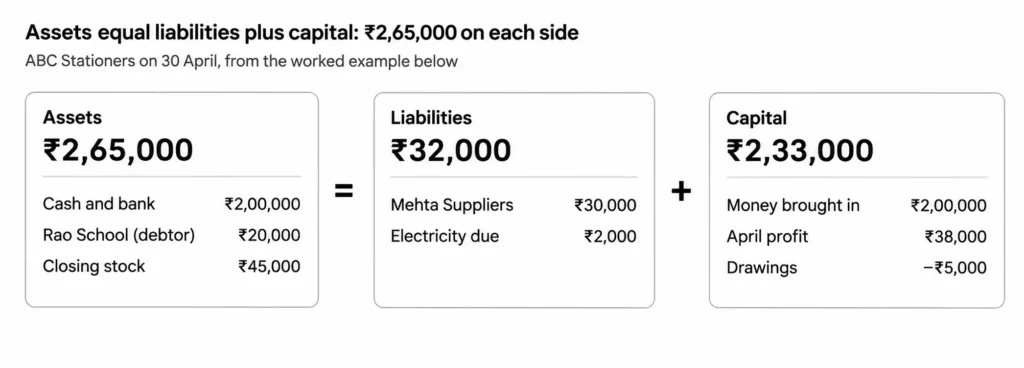
Every set of books rests on one equation: Assets = Liabilities + Capital. Assets are what the business owns, liabilities are what it owes, and capital is the money the owner has put in.
If you start a shop with ₹2,00,000 and buy goods worth ₹30,000 on credit, your assets become ₹2,30,000 (cash and stock), your liabilities ₹30,000 and your capital ₹2,00,000. Both sides still match.
What is Double Entry
Each transaction changes at least two accounts by the same amount. One account is debited (left side) and another is credited (right side). If you sell goods for ₹2,000 and the customer pays by UPI, you debit the bank account and credit the sales account by ₹2,000 each.
Golden Rules of Accounting
Type of Account
What It Covers
Debit
Credit
Examples
Personal Account
Customers, suppliers and owners
The receiver
The giver
Paid ₹5,000 to a supplier; the supplier’s account is debited.
Real Account
Cash, bank, stock and furniture
What comes in
What goes out
Bought furniture for ₹10,000 in cash; furniture is debited, and cash is credited.
Nominal Account
Sales, rent, salary, income and expenses
Expenses and losses
Income and gains
Paid ₹2,000 as rent; rent is debited and cash is credited.
For example, you pay ₹15,000 rent in cash. Rent is a nominal account (an expense), so you debit it. Cash goes out, so you credit it.
Basic Accounting Terms
Term
Meaning
Asset
Something the business owns, like cash, stock or a fridge
Liability
Money the business owes, like supplier dues or a loan
Capital
Money the owner has put into the business
Drawings
Money or goods the owner takes out for personal use
Debtor
A person who owes money to the business
Creditor
A person the business owes money to
Cash basis vs accrual basis: under the cash basis, you record income and expenses only when money moves. Under the accrual basis, you record them when they are earned or incurred. A credit sale made in April counts as April’s sale under accrual, even if the customer pays in May. Companies must use the accrual basis and double-entry accounting under the Companies Act, 2013.
Small businesses in India follow the Accounting Standards (AS) issued by ICAI. Indian Accounting Standards (Ind AS) apply only to listed and larger companies.
Different Types of Business Transactions
Businesses handle different kinds of financial transactions every day. Each one affects the business in some way.
Type
Example
Cash transaction
A customer pays ₹2,000 by UPI at the counter
Credit transaction
You buy goods worth ₹30,000 on 30 days’ credit
Non-cash transaction
A year’s depreciation of ₹5,000 on a fridge
Routine transaction
Daily sales, monthly rent, salary
Non-routine transaction
Buying a machine, taking a bank loan
One payment can include two entries. For example, if you sell products worth ₹22,000 on a marketplace, but the marketplace deducts a ₹2,000 fee, you receive only ₹20,000. In accounting, you record ₹22,000 as sales and ₹2,000 as a fee expense.
Not every event is a business transaction. For example, if a customer places an order worth ₹10,000 but you haven’t delivered the goods yet, you don’t record it as a sale. But if the owner takes ₹5,000 from the shop’s cash for personal use, it is recorded as drawings.
What are Goods in Accounting?
Goods are the items a business buys or makes in order to sell, also called stock-in-trade. Notebooks in a stationery shop and rice in a kirana store are goods, but the shop’s furniture is not. Goods are physical items, while services are work done for a customer, such as repairs.
GST law uses a wider meaning. Section 2(52) of the CGST Act, 2017 defines goods as “every kind of movable property other than money and securities”, including actionable claims, growing crops and grass.
Common mistake: recording a ₹50,000 fridge as a purchase of goods. It is not for sale, so it belongs in an asset account and is depreciated each year.
Cost of goods sold = Opening stock + Purchases − Closing stock. Closing stock is valued at cost or net realisable value, whichever is lower (AS 2).
You can track stock in two ways. A perpetual system updates the stock register with every sale and purchase. A periodic system counts stock only at the end of a month or year.
Accounting Period, Financial Year and Tax Year
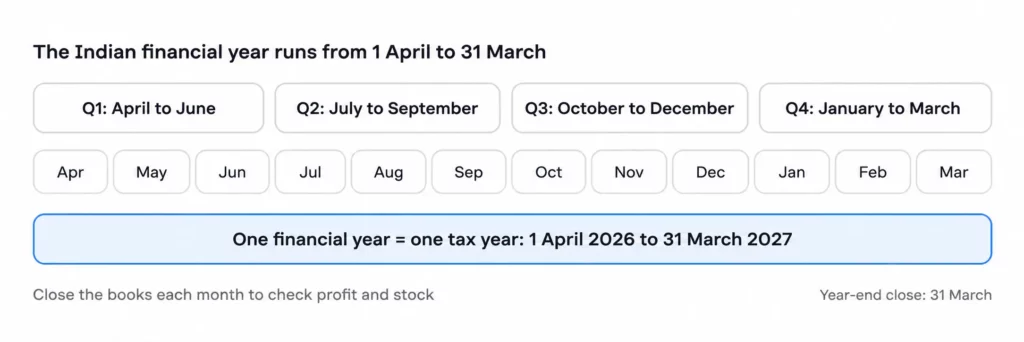
An accounting period is any stretch of time for which you close the books, such as a month, a quarter or a year. In India, the accounting year usually runs from 1 April to 31 March.
Under section 2(41) of the Companies Act, 2013, a company’s financial year ends on 31 March, with a narrow exception for some companies linked to a foreign parent. A proprietor may keep books on another year, like Diwali to Diwali, but income tax is still worked out for April to March, so most businesses stick to it.
The Income-tax Act, 2025 has been in force since 1 April 2026. Under section 3, the “tax year” is the financial year from 1 April to 31 March, replacing the old “previous year” and “assessment year”. A new business has a shorter first tax year: a shop opened on 10 August 2026 has its first tax year until 31 March 2027.
Financial Records and How Long to Keep Them
Financial records are the bills, books and reports that show every money transaction: invoices, purchase bills, receipts, bank statements, the day book, ledgers, the trial balance and the balance sheet. Keep them for the longest period any law sets for you.
Law
Applies to
Keep records for
CGST Act, 2017 (section 36)
GST-registered businesses
72 months from the due date of the annual return
Companies Act, 2013 (section 128)
Companies
At least 8 financial years
Income-tax Act, 2025 (section 62) and Rules (rule 46)
Businesses that must keep books
7 tax years from the end of the tax year
What Are Accounting Concepts?
Accounting concepts are the basic rules and ideas used when recording business transactions. They help businesses maintain accurate and consistent financial records.
Examples of accounting concepts:
Accounting Concept
Simple Meaning
Business Entity
The business and its owner are treated separately.
Money Measurement
Only transactions that can be measured in money are recorded.
Going Concern
The business is expected to continue operating in the future.
Accounting Period
Business accounts are prepared for a fixed period, such as a month or year.
Dual Aspect
Every transaction has two effects: debit and credit.
Matching Concept
Expenses are recorded in the same period as the income they help generate.
Consistency
The business should follow the same accounting methods from year to year.
What is the Accounting Cycle? The 8 Steps
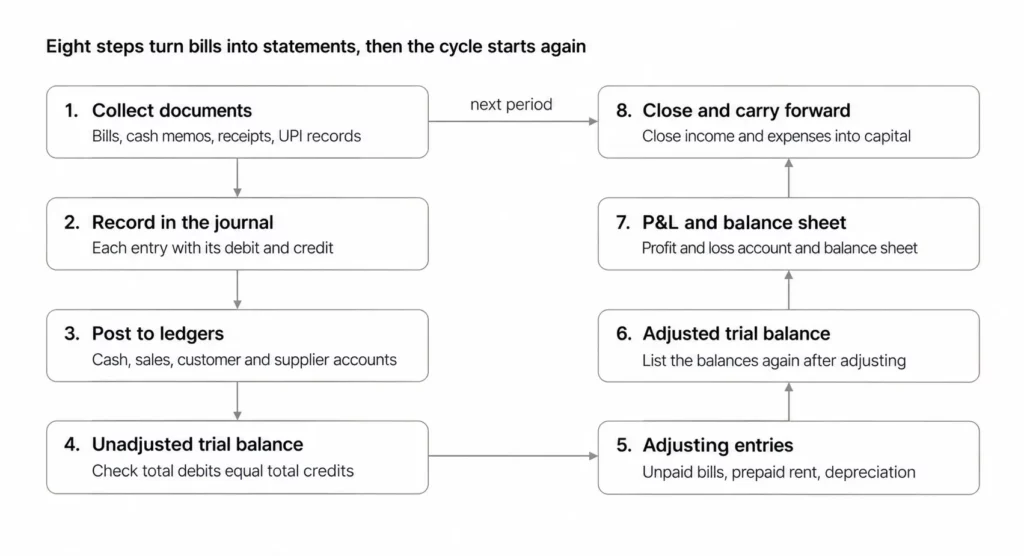
The accounting cycle is the set of 8 steps that take each transaction from its bill to the final statements. It then starts again for the next period.
Collect documents: gather bills, cash memos, receipts and bank or UPI records.
Record: write each transaction in the journal or day book with its debit and credit.
Post: move each entry to its ledger account.
Unadjusted trial balance: list every balance and check that debits equal credits.
Adjusted trial balance: list the balances again after the adjustments.
P&L and balance sheet: prepare the profit and loss account and the balance sheet.
Close and carry forward: close income and expense accounts into capital and carry the other balances forward.
Why it matters: the cycle gives you a profit figure you can trust every month, keeps your GST and income tax data ready, and gives banks the statements they ask for.
Most shops run the cycle every month for their own control and once a year for tax. Note that a balanced trial balance can still hide errors, such as a bill that was never recorded or a payment posted to the wrong party.
Difference Between Accounting Concepts and Accounting Cycle
Basis
Accounting Concepts
Accounting Cycle
Meaning
Basic rules and ideas of accounting.
Steps followed to record and report transactions.
Purpose
Helps maintain accurate financial records.
Helps complete the accounting process.
Nature
Rules and principles.
Step-by-step process.
Use
Followed while recording transactions.
Followed from recording transactions to preparing reports.
Examples
Business Entity, Dual Aspect and Going Concern.
Journal, Ledger, Trial Balance and Financial Statements.
A Case Study
ABC Stationers, a made-up shop in Pune, runs through all 8 steps in April. GST is left out to keep it simple.
Date
Entry
Amount (₹)
1 Apr
Owner brings in capital: Cash and Bank Dr, to Capital
2,00,000
3 Apr
Goods bought: Purchases Dr, to Cash ₹90,000 and Mehta Suppliers ₹30,000
1,20,000
5 Apr
Rent paid: Rent Dr, to Cash and Bank
15,000
18 Apr
Credit sale to Rao School: Rao School Dr, to Sales
20,000
25 Apr
Owner takes cash home: Drawings Dr, to Cash and bank
5,000
April
Cash and UPI sales: Cash and bank Dr, to Sales
1,10,000
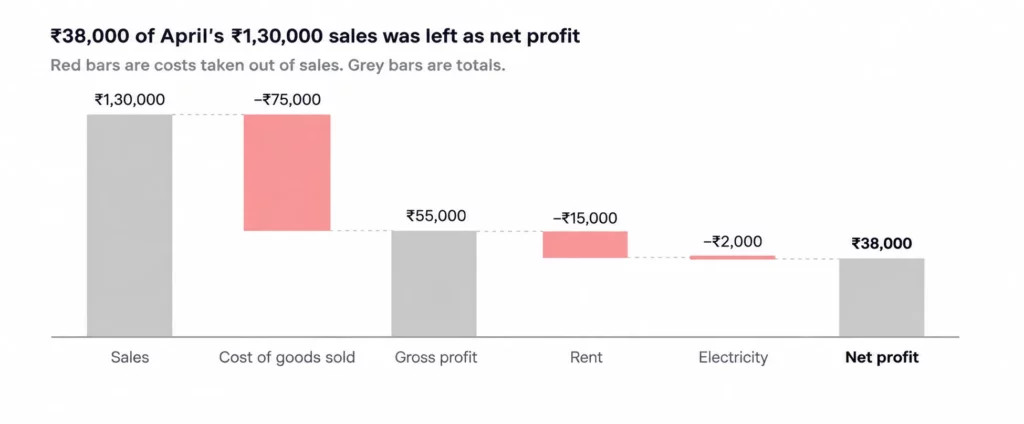
The unadjusted trial balance totals ₹3,60,000 on both sides. At month-end, April’s ₹2,000 electricity bill is still unpaid, so the owner passes Electricity Dr. to Outstanding expenses ₹2,000, and counts closing stock of ₹45,000.
Balance sheet on 30 April
₹
Cash and bank
2,00,000
Rao School (debtor)
20,000
Closing stock
45,000
Total assets
2,65,000
Mehta Suppliers (creditor)
30,000
Outstanding electricity
2,000
Capital (2,00,000 + 38,000 profit − 5,000 drawings)
2,33,000
Total liabilities and capital
2,65,000
Why profit didn’t show up as cash: the shop earned ₹38,000, but its cash stayed at ₹2,00,000. The profit sits in ₹45,000 of unsold stock and ₹20,000 due from Rao School, partly funded by ₹32,000 of unpaid bills, and ₹5,000 went home as drawings. A cash flow statement shows this gap in one place.
Common Mistakes in Basic Accounting
Mistake
Fix
Mixing personal and business spending
Record every personal withdrawal as drawings
Recording only cash, not credit sales or purchases
Record each credit bill on the day it is raised
Trusting a balanced trial balance
Match party balances and the bank statement every month
With Vyapar accounting software, each sale, purchase, expense and payment is recorded as you bill, whether paid by cash, UPI, card or bank transfer. The day book, trial balance, profit and loss account and balance sheet are ready as reports, so you never rewrite entries.
Adjusting entries: turn on the Accounting Module and journal entries in settings, then add a journal entry.
Your CA: on paid desktop plans, Accountant Access lets your CA review your books directly.
Frequently Asked Questions
Can I keep my business accounts myself without a CA?
Yes. Many proprietors record their own daily entries and monthly closing. You still need a CA where the law requires an audit or certification.
Can a business in India use January to December as its accounting year?
A company generally cannot, because the Companies Act, 2013 fixes 31 March as its year-end. A proprietor can, but income tax is still calculated for the April to March tax year.
What is the difference between an accounting period and a GST return period?
An accounting period is the span for which you prepare your own books. A GST return period is the month or quarter for which you report tax on the GST portal.
What happens if I miss recording a transaction?
The trial balance usually still tallies, so the error stays hidden until a party or bank balance doesn’t match. Record it as soon as you find it, in the period it belongs to.
What books should I keep from day one of a business?
A cash book, a sales and purchase record, party ledgers for customers and suppliers, and a stock register, along with every bill and bank statement that supports them.
I’m a business enthusiast with 8+ years of experience in business management and finance, holding a Bachelor of Business Management (BBM) in Marketing and an MBA in Finance. With expertise in marketing, accounting, financial management, business law, MIS, and business economics, I focus on simplifying complex business and finance topics into clear, practical insights for entrepreneurs, professionals, and students.
- "Tax Professional & Business Finance Expert"
Excel is a common starting point for small business accounting. It works well when transactions are limited, but managing sales, purchases, inventory, expenses, and GST in separate sheets becomes difficult as a business grows. So, when should you switch from Excel to accounting software? Let’s compare both options and understand what works best at different…
Cloud accounting keeps your books on a provider’s servers, and you open them over the internet from any phone or computer. Traditional accounting keeps them on one computer with installed software, or on paper and Excel. Cloud suits several users and remote access. Desktop suits a single counter with weak internet. Many apps now combine…
KEY TAKEAWAYS The 3 Golden Rules: They help decide which account to debit and which to credit. Know the Account Types: Identify whether an account is Personal, Real, or Nominal before applying the rule. Every Transaction Has Two Sides: Each transaction affects at least two accounts through debit and credit. Apply Them to Daily Transactions:…